Shifting Left: Where Software Quality Actually Lives
"Shift left" sounds like corporate nonsense. It's corporate nonsense that happens to be directionally correct about something important: bugs are cheaper to find and fix early.
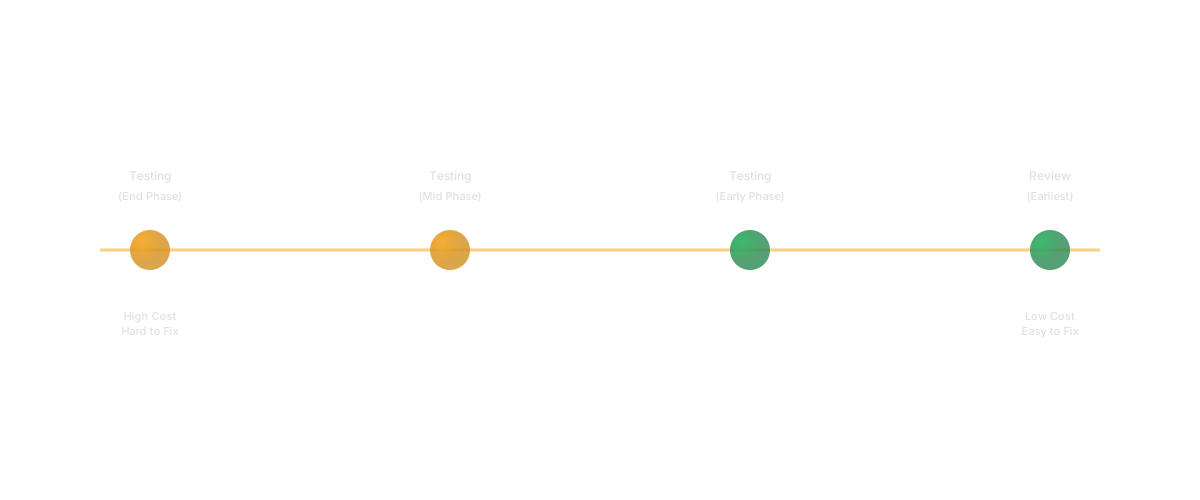
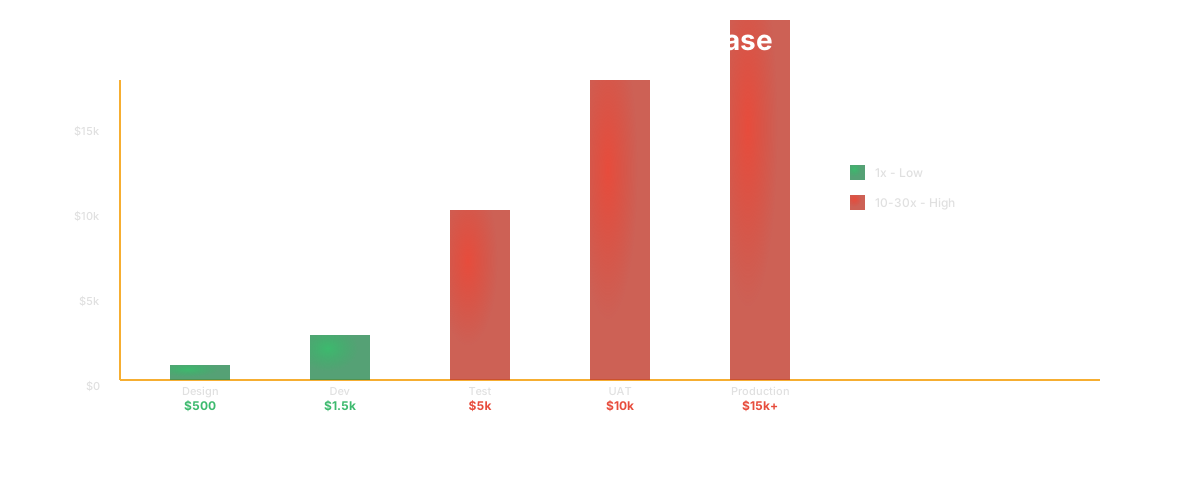
Barry Boehm published research in the 1970s showing that a defect found during requirements costs 1x to fix. During design, 6.5x. During implementation, 15x. During testing, 30x. After release, 60-100x. The exact numbers have been debated for 50 years, but the direction has never been questioned: early is cheaper.
The problem is people use this research to justify processes instead of practices. They build review bureaucracies and test gates instead of changing how engineers actually work.
What Shifting Left Actually Means
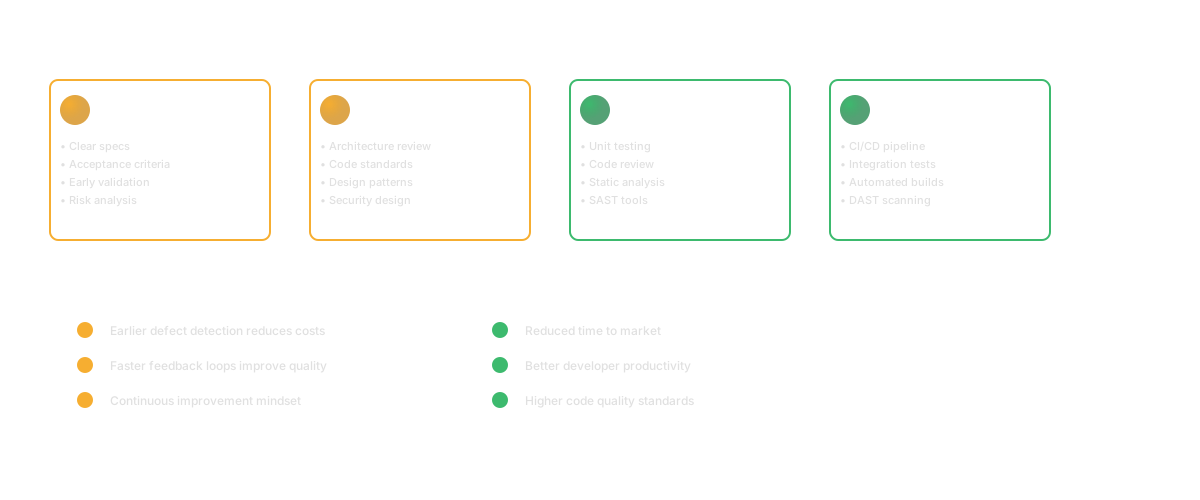
Shifting left means finding problems before they reach the problem-is-more-expensive phase. In practice, this is:
Test-driven development. You write tests before you write the code. This isn't about coverage metrics. It's about: you think through the spec so carefully that you can write test cases, and only then do you implement. This catches design problems before you've built complicated code.
Design reviews before implementation. Not architecture reviews after implementation. Before. A senior engineer looks at your design document and says, "Wait, have you thought about this edge case? What happens when..." You iterate on the design. Then you implement. The implementation is straightforward because the design is solid.
Security in CI, not penetration testing before release. Don't wait for a security team to break your system after you've built it. Run security checks in CI (dependency scanning, SAST, checking for hardcoded secrets). These are cheap, fast, and find real problems.
Design constraints built into frameworks. Your web framework makes SQL injection impossible by default (parameterized queries). Your API framework enforces rate limiting. Your deployment system prevents deploying without security headers. These aren't code reviews; they're built-in constraints that make the wrong thing impossible.
This is what shifting left means: making bad design decisions impossible or obvious before you've written hundreds of lines of code.
Where Shifting Left Works
Shifting left works great when:
Requirements are stable enough to test against. If you're building something you've never built before, and the requirements change every week, shift-left practices add friction. You write a test for the spec. The spec changes. Your test is now wrong. You rewrite the test. You rewrite the code. The return on investment is negative.
Shift left works best in: regulated industries (healthcare, finance) with stable requirements, mature products evolving carefully, and infrastructure code where the spec is set and performance/correctness are paramount.
The team has the discipline to actually do it. TDD requires discipline. It's slower at first. A team without ownership will skip tests. They'll say "we're just moving fast right now" and never come back to it. Don't do TDD unless your team will actually do it.
You have fast feedback loops. If your test suite takes 10 minutes to run, shift-left practices break. Test-driven development requires running tests every minute. You can't iterate if you're waiting.
Where Shifting Left Doesn't Work
Rapidly changing requirements. When the requirements change every two weeks, unit tests become a liability. You write a test. You implement. The requirements change. Your test is testing the old spec. You spend time updating tests instead of understanding the new requirements. This is a real cost, not an imaginary one.
In this case, shift left doesn't mean "more tests." It means "clearer requirements before implementation." And if the requirements are genuinely uncertain, accept that. Build something testable (clean architecture, dependency injection) so that when the spec changes, the code is easy to change.
Learning new domains. If you're building something you've never built and the team doesn't understand the domain, TDD is backwards. You need to learn first, then write tests. Build a prototype. Understand the problem. Then write proper code with tests.
Low-risk features. Not everything needs shift-left practices. Your critical path to revenue deserves it. Your admin UI for uploading CSV files probably doesn't. Shift left is an investment. Invest where it matters.
The Testing Pyramid
Most teams implement the testing pyramid upside down. The pyramid says: many unit tests (fast, cheap, run constantly), fewer integration tests (slower, more expensive, catch different problems), few end-to-end tests (slow, expensive, catch real-user problems).
Teams build it upside down: 10 end-to-end tests that take 30 minutes and are constantly flaky, some integration tests, and basically no unit tests. They think this is "testing the real thing" instead of "testing through too many layers."
The pyramid is right. Here's why:
Unit tests find logic errors. "Does this function handle negative numbers correctly?" They're fast (milliseconds). You can run thousands. They run constantly in development and in CI. They're cheap to write and maintain.
Integration tests find interaction errors. "Does the API properly reject invalid requests? Does the database transaction rollback work?" They're slower (seconds each) because they might spin up a test database. You can run dozens in your CI. They're expensive because they involve multiple components.
End-to-end tests find user flow problems. "Can a user actually sign up and log in?" They're slow (you're basically running the whole system and clicking buttons), expensive (you need a staging environment), and flaky (there are hundreds of things that can fail). You run a handful in CI before releasing.
Do all three types. The bulk of your tests should be unit tests. This is how you shift left: you find problems at the unit level, before they propagate.
Specific Shift-Left Techniques
Test-Driven Development (TDD): Write the test first. The test expresses what the code should do. Then implement code to pass the test. This forces you to think clearly about the spec before you code. Red (test fails), Green (test passes), Refactor (clean up the code).
Behavior-Driven Development (BDD): Like TDD but higher level. The test is written in plain language that non-engineers can read: "When a user logs in with valid credentials, they see the dashboard. When they log in with invalid credentials, they see an error." This forces clarity about spec and makes tests readable to non-engineers.
Property-Based Testing: Instead of writing individual test cases, you define properties that must always be true. "The sum of array elements plus the sum of each element individually should always be equal." The test framework generates thousands of random inputs to see if any violate the property. This finds edge cases you didn't think of.
Contract Testing: In microservices, Service A calls Service B. Instead of mocking Service B, you write a contract: "If Service A sends request X, Service B always responds with Y." Both services test against this contract. Service A tests that it sends the right request. Service B tests that it responds correctly. This is cheaper than end-to-end tests but finds real integration problems.
Why This Matters for Your Roadmap
Shifting left affects engineering velocity. A team with good shift-left practices can move faster long-term because they spend less time debugging production incidents and rework. A team without them moves fast initially, then hits a wall of complexity and accumulating bugs.
If your CTO tells you "we're going to slow down for two months to implement TDD and design reviews," they're not lying to you. You will go slower. Short term. Long term, you'll go faster. This is not something to debate on the basis of theory. Run an experiment. One team does TDD on a feature. Another team doesn't. Measure: time to implement, bugs found in code review, bugs found in production. Compare.
Connecting to Codebase Intelligence
Here's where Glue helps. Shift-left investment has a highest return when directed at code that's highest-risk: code that changes frequently, code that's been buggy, code that affects revenue.
Glue lets you ask: "Which parts of the codebase have the highest change frequency? Which parts have the highest fault rate (bugs found and fixed)? Where is the overlap?" The overlap is where your shift-left investment should go.
Or: "Which services have the lowest test coverage?" That's valuable input for prioritization.
Or: "Which changes to this code path required rework (we reverted them within a week)?" That's a sign the design was flawed. Next time you touch this code, do a design review before implementation.
Shift Left in 60 Seconds TL;DR
Finding bugs early is cheaper. Shift left means catching problems during design and unit testing, not after release. Practices: TDD (test before code), design reviews before implementation, security in CI, built-in constraints. Works well with stable requirements and disciplined teams. The testing pyramid: many unit tests (fast, cheap), fewer integration tests, few end-to-end tests. Upside-down pyramids fail.
Frequently Asked Questions
Q: Doesn't TDD slow us down?
A: Yes, initially. If you measure time-to-first-working-code, TDD is slower. If you measure time-to-working-code-with-no-bugs-that-need-fixing-later, TDD is faster. Most teams optimize for the wrong metric.
Q: We have rapidly changing requirements. How do we shift left?
A: Focus on code design (dependency injection, clear interfaces) and integration tests. Skip the unit test-heavy approach. Make sure your code is designed so that when specs change, the code is easy to change. Clear architecture matters more than test coverage.
Q: What test coverage should we target?
A: Not a number. Instead: 100% coverage of critical paths, 80-90% of core logic, lower coverage for UI and glue code. Coverage metrics are terrible at telling you if you're well-tested. Code review and incident post-mortems are better: "Did we have a test for this?" If yes but it didn't catch the bug, the test was bad.
Related Reading
- What Is Story Point Estimation?
- What Is Agile Estimation?
- Story Points Are Useless
- Velocity Doesn't Tell You How Far You Need to Go
- Glue for Engineering Planning
Further Resources