
As CTO at Salesken, the hardest part wasn't the technology — it was having the right information at the right time to make good decisions.
By Vaibhav Verma
The board asks you at the quarterly business review: "How healthy is our technical foundation?" You don't have an answer. You know it's not great ( - the team complains about the codebase), but you can't quantify it. So you give an anecdote: "We've got some legacy code, but we're managing it."
The board isn't satisfied. The CEO isn't satisfied. You're not satisfied. And the reason is that the most important question in the intersection of technology and business ( - "Is our technology holding us back or enabling us?" ) has no data behind it.
This is the CTO's visibility problem. You sit at the intersection of the engineering team (which understands the code in detail) and the business leadership (which cares about speed, reliability, and cost). Your job is to translate between them. But most CTOs can't answer the core question with data. They answer with instinct.
This guide is for CTOs who want to build a technical health dashboard that answers the questions the board is actually asking. Not dashboards full of engineering metrics that nobody understands. A dashboard that translates code health into business outcomes: "Here's our velocity trend. Here's how much technical debt is slowing us down. Here's our biggest risk."
By the end of this guide, you should be able to build a dashboard that your CEO will look at and understand. And more importantly, one that gives you data to argue for technical investment.
The CTO's Visibility Problem in 60 Seconds
Most CTOs know the technical reality ( - the codebase is getting harder to work with, the team is losing velocity) but can't explain it to business leadership using language they understand. You need four metrics: delivery velocity trend (are we shipping faster or slower?), technical debt accumulation rate (how much new debt are we taking on relative to what we're fixing?), production reliability by component (where do our incidents happen?), and estimated future impact (what will current debt cost us in missed roadmap commitments?). If you can report these four things with confidence, you've solved the visibility problem.
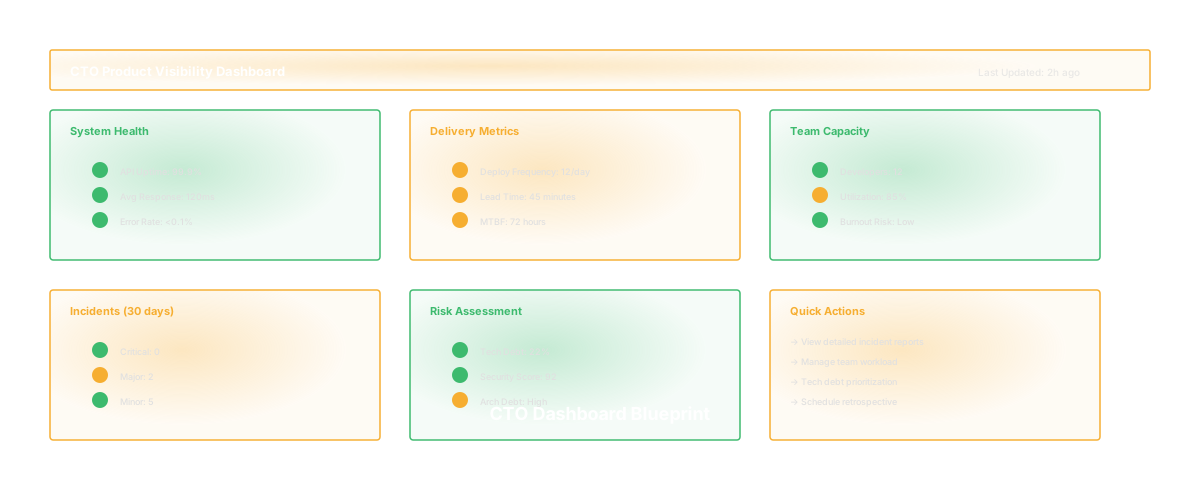
The Visibility Problem: Why You Can't Answer the Board's Questions With Data
Here's the normal conversation:
CTO: "Yes, we have some technical debt but we're managing it." CEO: "What does that mean for our roadmap?" CTO: "We'll hit most of our targets but some features will take longer because of legacy code." CEO: "How much longer?" CTO: "...not sure exactly. Maybe 20-30%?" CEO: "That's concerning. Can you quantify it?" CTO: "That's what I'm working on..."
That conversation ends with the CEO not trusting your answers. Because you don't have answers; you have guesses.
The problem isn't that you don't understand the technical reality. You do. The problem is that you don't have a translation layer between "the authentication module has a cyclomatic complexity of 42 and a failure rate of 12%" and "shipping authentication-related features takes 40% longer than we estimate because of the code quality."
The visibility gap has real consequences. First, the board makes decisions without understanding the technical constraints. They commit to roadmaps that aren't achievable given the technical debt. Then you miss commitments, lose credibility, and the technical debt becomes invisible again because nobody wants to hear about it. Second, you can't make the case for technical investment. Without data showing that technical debt is costing you velocity, the CEO says "just ship faster." With data showing that cleaning up the authentication module would free 15 story points per sprint, the conversation changes. Third, you have no way to prioritize which debt to address. Everything is "critical," so nothing gets addressed. With data about which modules are causing the most failures or taking the longest to change, you can be strategic.
The fix is visibility. Real, quantifiable, reported-to-the-board visibility.
What the Board and CEO Actually Want to Know
Your board doesn't want to know your technical debt score. They want to know:
Are we in better or worse shape than we were six months ago? Is our technical foundation getting stronger or weaker? Are we investing in the platform, or are we mortgaging it for short-term features?
How is technical debt affecting our delivery timeline? What percentage of our engineering capacity is going to fixing problems rather than building new features? If we reduced technical debt by 20%, how many more features could we ship?
What's our biggest technical risk? Where are we most vulnerable? If a critical system fails, how fast can we recover? Are there architectural decisions that could sink us if they fail?
Are we confident in our roadmap? Can we actually ship everything we committed to? What are the technical blockers? Can we move faster if we make certain architectural changes?
These are all business questions that happen to have technical answers.
The Four Metrics the Board Needs to Understand
Metric 1: Delivery Velocity Trend
Velocity is the amount of work you ship per sprint. Most teams track this already. What you need is the trend. Is your velocity flat, improving, or degrading?
The board cares about this because velocity is a proxy for how fast you can ship new features. If velocity is degrading, you're shipping slower every sprint. That has nothing to do with engineering effort ( - the team is trying) and everything to do with technical debt making code harder to work with.
How to measure: Track your sprint velocity for the last eight quarters. Normalize it (so you can see the trend even if team size changes). If your trend is downward, you've got a technical debt problem.
What to show the board: A simple graph showing velocity over time. If it's declining, here's why: the codebase has high complexity in critical modules, code changes are taking longer because of tight coupling, and engineers spend 25% of their time fixing technical debt. The message: "We're slowing down not because the team is less capable, but because the code is getting harder to work with."
Metric 2: Technical Debt Accumulation Rate
Debt accumulation rate is: new complexity introduced per sprint minus complexity removed per sprint. If you're shipping features that add 50 points of complexity and refactoring work that removes 15 points, your net debt accumulation is 35 points per sprint.
The board cares about this because if your debt is growing faster than you're paying it down, you're on a one-way track to velocity collapse.
How to measure: Use your code complexity metrics (cyclomatic complexity, coupling metrics, etc.). Track: for each sprint, how much complexity did new code add? How much complexity did refactoring remove? The difference is your accumulation rate.
What to show the board: "Our technical debt is accumulating at 30 points per sprint. At this rate, in 12 months our velocity will have declined by an estimated 20% due to code quality. If we invest 40% of engineering capacity in debt reduction for the next two quarters, we can stabilize our velocity. Then we can start improving."
The conversation changes when you have that data. The CEO sees it as an investment problem, not a nagging engineering complaint.
Metric 3: Production Reliability by Component
Which parts of your system fail most often? Which components cause the most incidents? Which modules require the most hotfixes?
The board cares about this because every incident costs money ( - outages, support load, lost customer trust). If you can reduce incidents by 30% by improving code quality in your top three failing modules, that's a business case.
How to measure: For the last 90 days, track incidents by component. For each component, count how many incidents, how long they took to resolve, and what the approximate business impact was. Rank them by frequency and impact.
What to show the board: "The payment processing module caused 8 incidents in the last quarter, costing us an estimated $500k in lost transactions and support time. The module has high complexity and tight coupling that makes debugging incidents slow. Investing two weeks of refactoring would reduce incidents by 70%."
Suddenly technical investment has a specific ROI.
Metric 4: Estimated Future Impact on Roadmap
This is the forward-looking question: given our current technical debt, what will the next roadmap look like? If we commit to the features the product team wants, will we hit them on time, or will technical constraints slow us down?
How to measure: Get your product roadmap for the next three quarters. For each feature, ask: "What modules will this touch?" Then look at the health of those modules. Complex modules, high coupling, low test coverage ( - all signals that this feature will take longer. Estimate the cost multiplier. If a feature would normally take 3 weeks in a clean module but the target module has complexity issues, maybe it takes 4.5 weeks.
What to show the board: "Based on our technical debt levels, we can ship 85% of the planned roadmap on schedule. Here are the features that will be delayed: (list). Here are the technical investments that would unblock them: (list and estimates). If we do those investments, we can hit 100% of the roadmap."
This is the conversation where technical investment becomes a business decision.
Building a Technical Health Dashboard for Leadership
You're not building a dashboard for engineers. You're building one for the CEO, the board, and the product leadership. It needs to answer the four questions above and it needs to be understandable to someone who doesn't code.
The Visual Design
Use trend lines, not absolute numbers. The CEO doesn't care that your velocity is "47 points." They care that it's declining from 50 to 47 to 45. That's the story.
Use red/yellow/green indicators. "Code health: Yellow (degrading)" is immediately understood. "Cyclomatic complexity: 18.3" is meaningless to a CEO.
Use analogies people understand. "Our critical payment processing module is yellow ( - it's starting to show signs of instability). If we don't invest in stabilization, it will be red within two quarters." That's a conversation the board can follow.
The Dashboard Content
Create four panes:
Pane 1: Velocity Trend (last 8 quarters) Graph of velocity over time. Green if flat or improving. Yellow if declining. Include the estimated quarterly impact of technical debt on velocity (e.g., "Technical debt cost us an estimated 12% velocity decline this quarter").
Pane 2: Technical Debt Accumulation Stacked bar chart showing: new complexity added per quarter, complexity removed per quarter, net accumulation. Green if net is negative (paying down debt faster than adding it). Red if net is positive (debt growing).
Pane 3: Reliability by Component Table showing: top 5 components by incident count, incidents per quarter, mean time to resolution, estimated business impact. Use red to highlight components with increasing incident rates.
Pane 4: Roadmap Confidence Simple statement: "Planned roadmap delivery confidence: 85%." Detail which major features are at risk due to technical constraints. Show the estimated technical investments to increase confidence to 100%.
The Cadence
Update the dashboard quarterly. Show it at the board meeting. Use it as the context for any technical investment asks. When the CEO says "the product team wants to ship 10 more features next quarter," you have a data-driven conversation: "We can ship X of those features on time given current technical health. To ship all 10, we need to invest in paying down debt in these modules: (list)."
The Conversation With the Board: Framing Technical Investment as Business Decision
Technical work is not free. Refactoring takes engineering time that could be spent on features. Your job is to make that tradeoff explicit and quantifiable.
Here's the framework:
Start with business outcome. "Our goal is to improve delivery velocity from 45 points/sprint to 55 points/sprint."
Identify the technical constraint. "The primary constraint is code complexity in our three most-modified modules (auth, payment, recommendations). Engineers spend 30% of their time debugging and fixing issues in these modules instead of shipping new features."
Quantify the investment. "Refactoring these three modules will take approximately 200 engineer-weeks over the next two quarters. During this time, we'll ship fewer new features ( - approximately 40 fewer story points per sprint)."
Show the ROI. "Once complete, velocity will increase to 55 points/sprint. The payback period is two quarters. After that, we're shipping 10 additional story points every sprint, or 20% more features for the same engineering headcount."
Present the alternative. "If we don't invest, velocity will continue to degrade. We estimate velocity will be 35 points/sprint by next year, meaning we'll be shipping 30% fewer features despite having the same team. We'll also have higher incident rates and slower time-to-fix."
The board doesn't care about code purity. They care about: velocity, reliability, and cost. Frame technical investment in those terms.
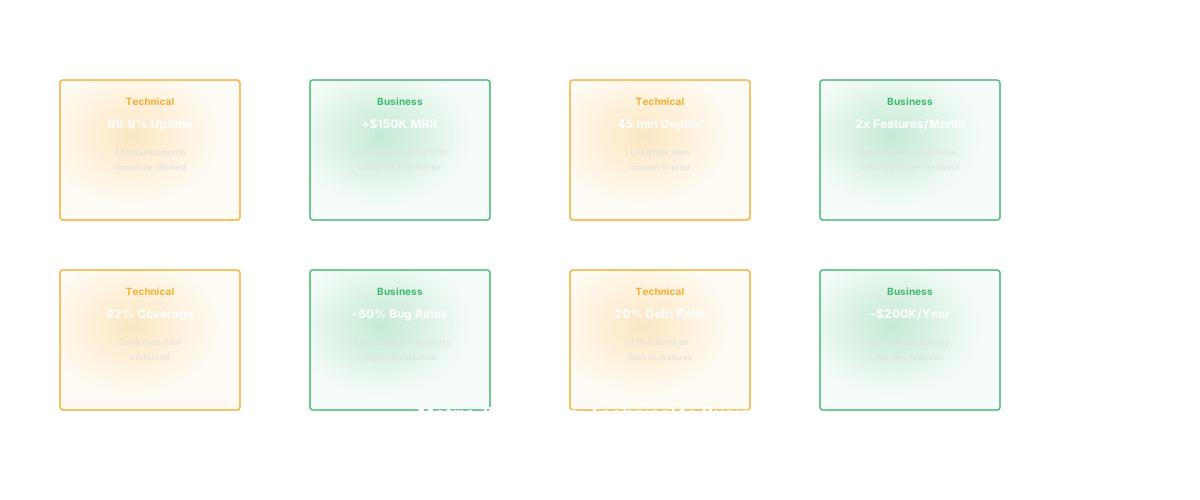
Common Mistakes CTOs Make in Reporting Technical Health
Reporting code metrics to non-technical audiences. "Our cyclomatic complexity increased from 12.4 to 13.1" means nothing to a CEO. "Code quality is declining, which will add approximately 5-10% to feature development timelines" means everything.
Conflating velocity with health. High velocity doesn't mean the codebase is healthy. You can have high velocity with increasing technical debt if you're taking shortcuts. You can have low velocity with a healthy codebase if you're being cautious. Report them separately.
Not connecting technical health to product outcomes. The CEO doesn't care about code quality in the abstract. They care about shipping speed, reliability, and cost. Connect technical metrics to those outcomes.
Only reporting problems, never solutions. "Our codebase is a mess" is not a useful report. "Our codebase has specific problems in these modules. Fixing them would improve velocity by 20%. Here's the investment required." That's a useful report.
Waiting for perfect data before reporting. You don't need perfect metrics. You need honest, directional metrics. Quarterly reviews with "estimated impact" are better than perfect metrics that arrive six months late.
Treating all incidents the same. An incident in the critical path is different from an incident in a rarely-used module. Weight your reliability metrics by business impact, not just frequency.
How Glue Helps
Glue automates the measurement and translation of technical health into business metrics. You don't need to manually run complexity analyses, correlate incidents to code modules, or estimate impact. Glue does this continuously.
You ask Glue: "How much is technical debt costing us in delivery speed?" and Glue shows you the answer with data. You ask "Which modules are causing the most incidents?" and Glue shows you the modules and their characteristics ( - complexity, coupling, test coverage) that explain why. You ask "What would it cost to fix our biggest technical problems?" and Glue helps you estimate based on the scope and complexity of the work.
Glue turns the CTO's visibility problem into a solved problem. You have data. You have credibility. You can make technical investment decisions as a CEO partner, not as a pleading engineer.
Frequently Asked Questions
Q: My board doesn't care about technical debt. How do I get them to care?
Show them the impact in business terms. "Technical debt cost us 15% velocity decline this quarter" gets their attention more than "we have code quality problems." Connect debt to outcomes: slower features, higher incidents, higher costs. Once they see the business impact, they care.
Q: How do I know if my technical investment is actually working?
You'll see it in velocity trend and incident rates. If you invest $200k in refactoring and velocity improves by 10% or incidents decline by 20%, the investment worked. If neither changes, either the investment didn't address the right problem or you need to measure something else.
Q: What if my CEO wants me to always prioritize features over technical work?
Use your data. "We can ship more features this quarter if we skip technical work. But our codebase will continue degrading, and velocity will decline by an estimated 5-8% next quarter. At what point is it worth investing in stability?" Let the data inform the decision instead of fighting about it.
Q: How often should I update the technical health dashboard?
Quarterly is the right cadence for the board. Internally, you might review monthly with your engineering leadership. The board sees it when they need to make strategic decisions.
Related Reading
- Programmer Productivity: Why Measuring Output Is the Wrong Question
- Developer Productivity: Stop Measuring Output, Start Measuring Impact
- DORA Metrics: The Complete Guide for Engineering Leaders
- Engineering Efficiency Metrics: The 12 Numbers That Actually Matter
- What Is a Technical Lead? More Than Just the Best Coder
- Software Productivity: What It Really Means and How to Measure It