Glossary
Codebase intelligence uses automated analysis and AI to extract business-relevant insights from source code - helping product managers, engineering leaders, and executives understand system architecture, dependencies, quality, and risk without needing to read the code themselves.
Codebase intelligence is the application of automated analysis and AI to extract meaningful, business-relevant information from source code - making a codebase understandable not just to the engineers who wrote it, but to product managers, engineering managers, founders, and other stakeholders who need to make decisions about the product. It answers questions like: What features does the product have? How is that feature implemented? What parts of the codebase are most volatile? Which modules have the highest coupling? What's the recent change history in this system? How long does it take to ship a change to this feature? Codebase intelligence is distinct from related categories: code search (grep-style searching, finding where something is), static analysis (security scanning, quality checks), and AI coding assistants (Copilot, Cursor - tools that write or suggest code). Codebase intelligence is about understanding the system. It's about providing visibility into architecture, dependencies, change patterns, and feature implementation to humans making decisions about the product. This category exists now because modern codebases are too large for any individual to understand completely, AI has become capable of navigating that complexity, and product teams have discovered they need technical context to make better decisions.
Product velocity depends on understanding what code will do. When a PM asks "Can we ship feature X in two weeks?", the question is ultimately about code: How much code needs to change? How complex is that change? What dependencies exist? Is there test coverage? The answer requires codebase visibility. Without it, PMs estimate based on hope or experience with other codebases. With it, estimates are grounded in actual system facts.
Codebase intelligence also enables better feature ownership. A product might have 50 features. Some are owned by a single engineer, some by a team, some are fragmented across three systems. When features are owned by single engineers, that engineer becomes a bottleneck - they know the code, so they handle questions, reviews, and changes. When a product manager doesn't know this, they make roadmap decisions that inadvertently overload the bottleneck. Codebase intelligence reveals ownership patterns and lets PMs see: "Feature A is owned by one engineer and also on the critical path. That's risky." The response might be knowledge transfer, refactoring, or deferring other work owned by that engineer.
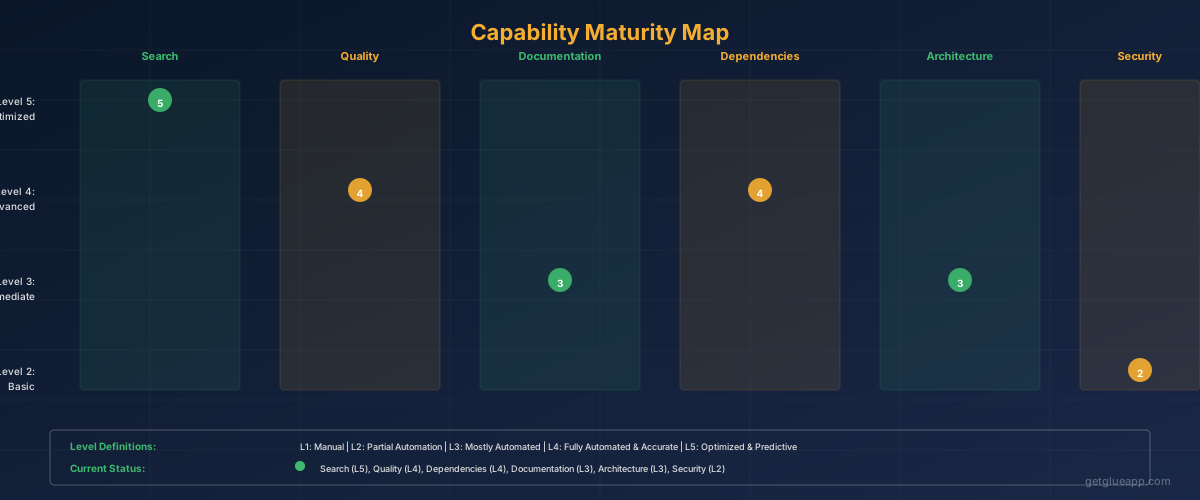
The third value is competitive analysis. A product manager preparing to competitive sell needs to know: Does our product support X? Does the competitor? How is X implemented in our codebase? Is it well-designed or a hack that's been there since 2020? That level of detail about your own product beats competitive assumptions every time. Codebase intelligence provides it.
The fourth value is technical debt visibility. Technical debt is the accumulated messiness in a codebase - complexity, duplication, poor test coverage, high coupling. It's invisible without measurement. A PM might think the team is slow because the team is understaffed. The real reason might be that the codebase is 40% duplication and making changes anywhere creates cascading failures. Codebase intelligence measures debt, makes it visible, and lets PMs prioritize debt reduction as a business problem ( - not a quality problem, a velocity problem).
Scenario 1: A PM is planning Q2. They want to add API v2 because customers complain about limitations in the current API. Before committing to the roadmap, the PM asks codebase intelligence: "How long did the current API take to build? What's the code quality? Are customers on it or still on v1? How much of the product depends on the API?" The answers determine whether building a new API is a win ( - ) customers move to it, quality improves) or a loss ( - ) two APIs are maintained, no one migrates). A well-implemented API in low-debt code might take six weeks to rebuild as v2. A badly-implemented API in high-debt code might take six months. Codebase intelligence clarifies this before the PM commits.
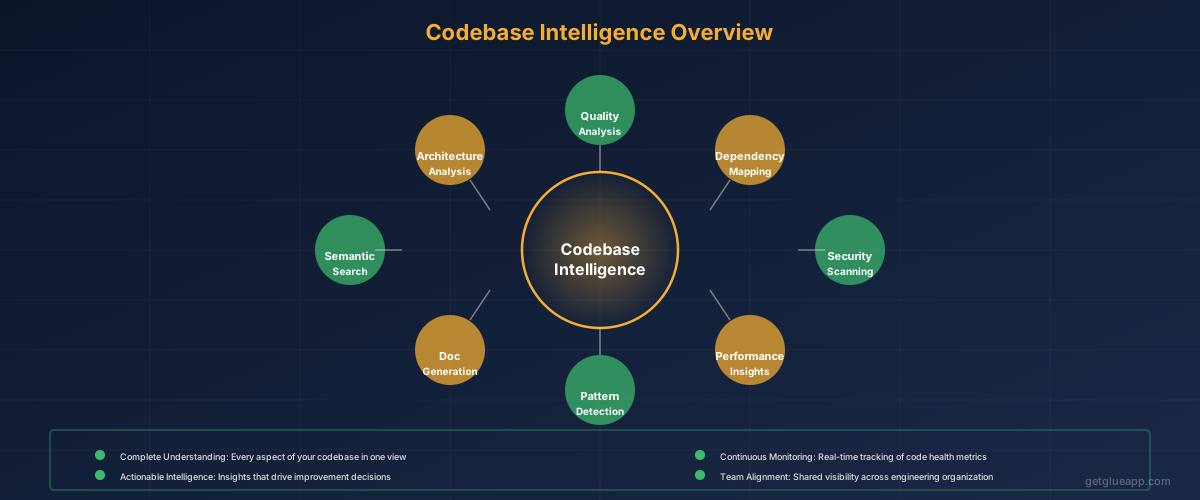
Scenario 2: An engineering manager reviews a proposal to refactor the authentication module. The team believes it will improve velocity on authentication features. The manager asks: "How many engineers touch this module? How frequently? What's the change failure rate? What's the test coverage?" Codebase intelligence answers: The module touches 3 features, 2 engineers work on it, change failure rate is 8% (low), test coverage is 65% (medium). Refactoring improves velocity only if it solves a known constraint. If the module is stable and rarely changed, refactoring is waste. If it's volatile and high-failure, refactoring is worthwhile. Data changes the decision.
Scenario 3: A founder asks the CTO: "What's our actual competitive advantage in the product, technically speaking?" This is a business question, not a technical one. The answer requires codebase visibility. "We have proprietary machine learning models that we trained on 10 million data points from three years of customer usage. That's hard to replicate." Or: "Our primary advantage is scale - we've optimized the database layer for throughput in ways competitors haven't." Or: "Honestly, I'm not sure. Let me look at the codebase." With codebase intelligence, the CTO can answer authoritatively by querying what's proprietary, what's commodity, where the complexity is, and what moats exist.
Codebase intelligence begins with questions. What do you need to know about the codebase? Common categories:
Feature understanding: What features exist? How are they implemented? Where is the code? What's the quality? When was it shipped?
Complexity mapping: Which modules are the most complex? Which have the highest coupling? Where is the debt concentrated?
Change analysis: What parts of the codebase change frequently? What's the failure rate for changes to each module? What's the change latency ( - time from commit to production)?
Ownership and risk: Who owns each feature? Which features are fragile (high failure rate) and single-threaded (owned by one engineer)?
Competitive technical advantage: What parts of the codebase are proprietary vs. commodity? Where is the value?
With questions defined, codebase intelligence tooling analyzes the code to answer them. The analysis includes:
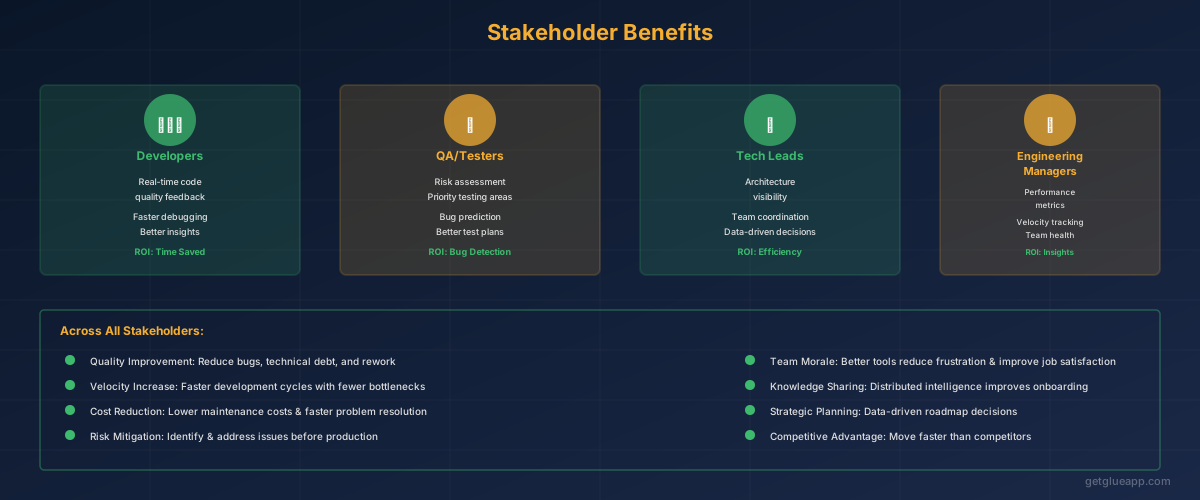
Product teams apply these insights to roadmap decisions, resource allocation, and risk management. Engineering teams use them to prioritize refactoring and identify knowledge gaps that require attention.
"We have code search, so we have codebase intelligence." Code search finds where things are. Codebase intelligence understands what things do and why they matter. "Find all references to the auth function" is code search. "Which systems would break if we removed the auth function?" is intelligence. The second requires understanding relationships, dependencies, and impact.
"ChatGPT can do this." AI chatbots work well for questions about small code snippets or well-documented systems. Codebase intelligence at scale requires sustained context. Holding 500,000 lines of code in working memory to answer questions requires specialized tooling. A chatbot can answer "What does this function do?" A codebase intelligence system can answer "What's the failure rate of changes in this module, and how does it correlate with complexity?"
"This is just static analysis and linting." Static analysis finds problems (undefined variables, security issues, style violations). Codebase intelligence identifies patterns and trends. "This module has low test coverage" is static analysis. "This module's test coverage is declining, but the change frequency is increasing, indicating growing risk" is intelligence. Intelligence requires historical context, not just point-in-time analysis.
Q: How long does it take to set up codebase intelligence? Minutes for the tooling to scan the codebase, hours for the first custom analysis. The setup cost is low; the sustained value depends on how regularly the intelligence is used in decision-making.
Q: What size codebase does codebase intelligence apply to? Small codebases ( - under 50k lines) don't need it; any engineer can understand the system. Medium codebases (50k-500k lines) benefit significantly - visibility is valuable. Large codebases (500k+ lines) require it; no individual can hold the system in working memory.
Q: Can we use codebase intelligence to measure engineering productivity? Partially. Codebase intelligence can measure output (commits, PRs, features shipped) and quality (test coverage, failure rate, refactoring frequency). True productivity includes learning and unplanned work that codebases don't directly measure. Use codebase signals as one input to productivity discussions, not as the only signal.
Keep reading