
Technical Debt Statistics 2026
Technical debt costs engineering teams a median 17% of total capacity according to Stripe's landmark study, with companies at the 75th percentile losing 25–30% of engineering time to debt maintenance. Key statistics: 33% of developer time is spent on maintenance work (GitHub), AI-generated code accelerates debt creation by 3–4x, and companies spending above the median lose the equivalent of 5+ engineers per 30-person team. Measuring debt quantitatively — through cyclomatic complexity, code duplication, test coverage gaps, and code churn — transforms it from an invisible tax into a budgetable line item.
At Salesken, we had a 'tech debt' label in Jira with 200+ tickets. When our board asked how much technical debt we had, I couldn't give them a number. That experience taught me that unmeasured debt is invisible debt.
By Arjun Mehta
Technical debt costs you money. Real money. Here are the numbers.
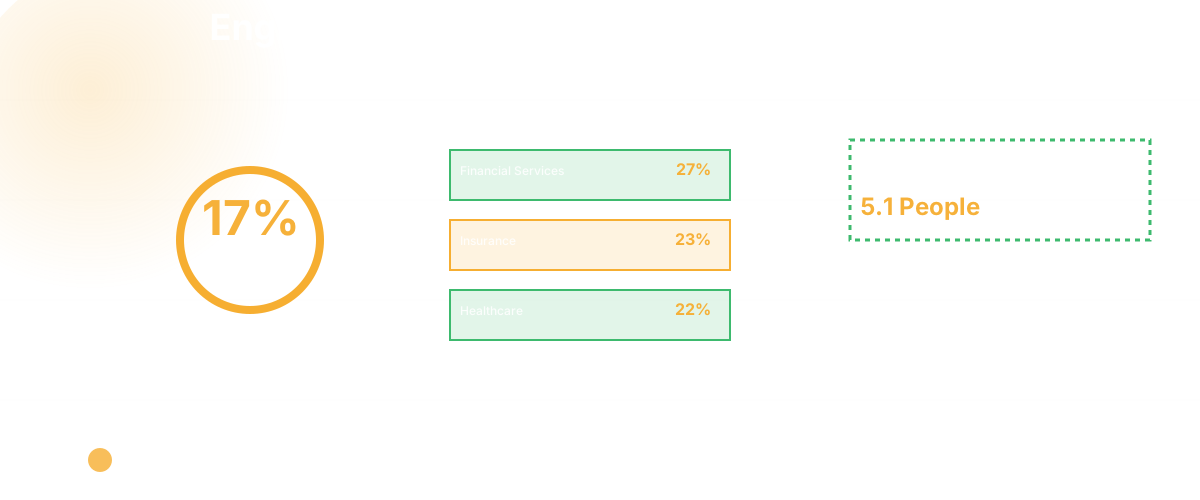
Stripe conducted a landmark study in 2023 asking engineering leaders about technical debt. The median company estimated they spend 17% of engineering capacity on technical debt maintenance. Seventeen percent. That means on a 30-person engineering team, five people are full-time on keeping the lights on instead of building new features.
For some industries, it's worse. Financial services companies reported spending 27% of capacity on debt. Insurance companies 23%. Healthcare 22%. Understanding GAAP rules for software capitalization helps finance teams allocate this spend accurately. Stripe's own estimate extrapolates to 2.41 trillion dollars globally spent annually on technical debt maintenance alone. Not the cost of incidents caused by debt. Not the cost of customers churning because systems are fragile. Just the cost of engineers maintaining systems instead of improving them.
Let me be direct: if you're not measuring your own technical debt, you're probably spending more than 17% of engineering time on it, you just don't know it.
Here's what that actually means. You have a 30-person engineering team. You've planned 600 engineering days of work this quarter (30 people × 20 working days, roughly). If 17% is debt, that's 102 days of engineering time, or 5.1 person-months, going toward maintenance, refactoring, and keeping systems functional. That's not new features. That's not revenue. That's the cost of systems you've already built.
The thing that strikes me about this data is that most leadership teams have never quantified it. They know debt exists. They know it slows things down. But they don't know it's five people's worth of work. When you put it that way ( - ) "we could hire two more engineers to build features, or we could spend five engineers fixing the mess we've already built" ( - ) suddenly the incentive structure changes.
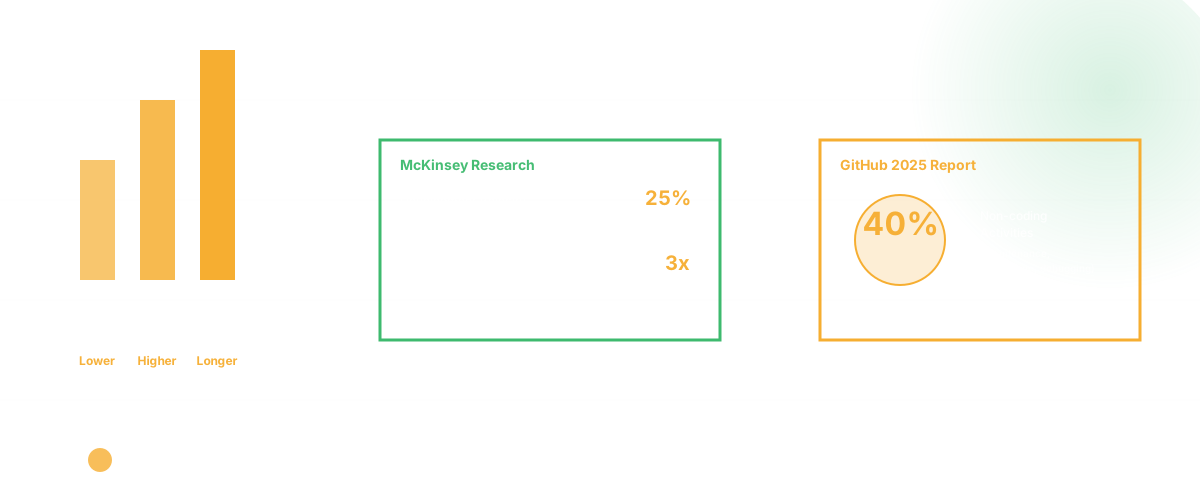
Here's where it gets worse: high-debt teams are slower at literally everything. The DORA metrics (tracked by Google and now widely adopted by engineering organizations) show that high-tech-debt teams have:
- Lower deployment frequency (features take longer to release)
- Higher change failure rates (changes break things more often)
- Longer time to recover from incidents (when things break, fixing them takes longer)
McKinsey found that engineering teams with significant technical debt have 25% slower development velocity and 3x longer incident recovery times. That's not just a number on a dashboard. That's revenue risk. That's customer impact.
GitHub's 2025 State of Software Development report found that developers spend an average of 40% of their time on "non-coding activities" ( - ) which is a polite way of saying maintenance, refactoring, and debugging legacy code. Forty percent. Developers aren't writing features. They're cleaning up.
The Stack Overflow Developer Survey found that the top reasons developers leave companies are: "legacy code I have to maintain" and "technical debt that slows development." It's not just a productivity problem. It's a retention problem. Good engineers don't want to spend their careers in debt-ridden codebases.
Now here's the meta-point: technical debt in AI-augmented codebases grows faster. GitHub Copilot and Claude can generate features incredibly fast. What they don't do well is refactor, redesign systems, or pay down debt. Teams using AI coding tools are shipping features faster, but they're accumulating debt faster too. The debt-to-feature ratio is getting worse, not better.
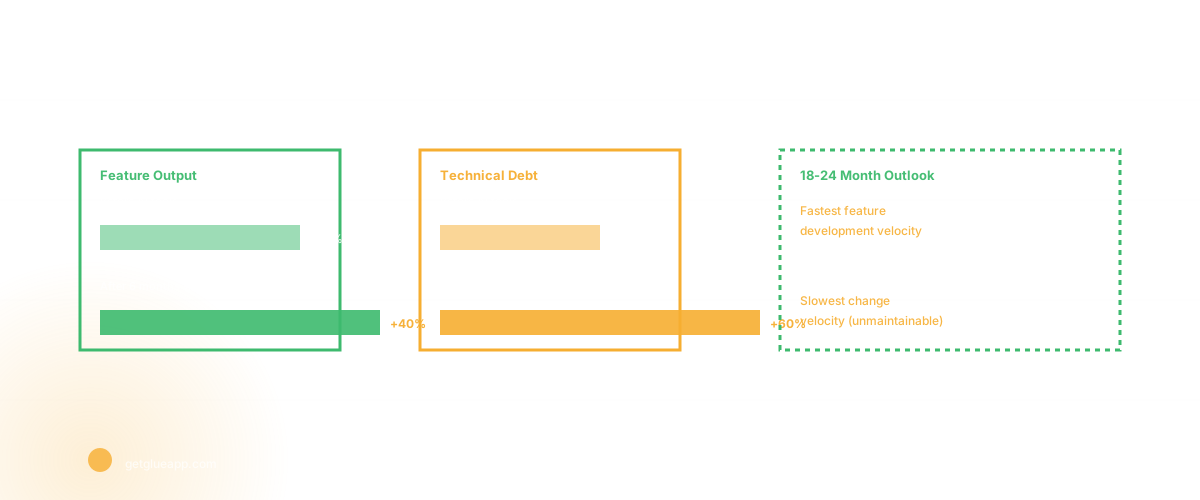
I've watched this happen in real time. Teams that started using AI assistants six months ago are shipping 40% more features and 60% more technical debt. They're mortgaging the future for today's features. In two years, they'll have the fastest feature development and the slowest change velocity.
The solution isn't to stop using AI coding tools. The solution is to make technical debt visible and then treat it like a real cost. Not "we'll pay it down when we have time." Time never comes. Treat it like a budget line. Allocate time for it. Measure it. Track whether it's growing or shrinking.
Here's the operational reality: teams that measure and actively pay down debt have slower short-term feature velocity and way higher long-term velocity. Teams that ignore debt have a velocity cliff in 18-24 months when the debt becomes unmaintainable.
The best teams I've worked with allocate 20% of engineering time to debt paydown. Not 5%. Not 10%. Twenty percent. It's intentional. It's budgeted. It shows up on the roadmap. Engineering leaders explicitly say "we're shipping fewer features this quarter because we're paying down debt." And six months later, they're shipping more features because the codebase is maintainable again.

What stops most teams is that debt is abstract. You can't see $2.41 trillion of wasted engineering time in your own codebase. You just feel it. The sprints run long. The estimates are soft. People talk about "the mess" but nobody's quantified it.
Here's what actually works: measure your own debt. Find the parts of your codebase with the highest complexity, the lowest test coverage, the most churn. Quantify the cost using coding metrics. "We have 47 files with cyclomatic complexity above 25. We estimate those cost us 80 engineering hours per quarter in maintenance." Suddenly it's real. Suddenly you can make a business case for paying it down.
The numbers from Stripe and McKinsey and GitHub aren't just industry trivia. They're predictive of what's happening in your codebase right now. If you're above average, you're losing more than 17% of capacity. If you've been shipping fast and ignoring refactoring, you're in the 25-30% range. If you started using AI coding tools six months ago, you're accelerating into a debt cycle.
The good news is that debt is addressable. It's just a priority and a budget. The bad news is that if you can't see it, you can't fix it.
Frequently Asked Questions
Q: Is 17% of engineering time on debt realistic for a startup? No. Early-stage startups typically spend less on debt because the codebase is small and manageable. You'll see this number creep up as you scale. By the time you're a Series B company, 17% is realistic. The companies spending 25%+ are usually post-Series C with inherited debt from multiple acquisitions and rapid scaling.
Q: How do we actually measure debt in our codebase? Start with code complexity metrics (cyclomatic complexity, code duplication), test coverage, and churn (how often is code being modified). Tools like Sonarqube or codebase intelligence platforms will calculate these. Then estimate the cost: "high complexity code takes 2x longer to modify." Tracking code quality metrics and change failure rate helps quantify the real impact. Build up from there.
Q: If debt costs us so much, why do we ever take it on? You take on debt because you trade future velocity for today's speed. You need to ship something fast, so you build it quickly instead of building it right. That's a reasonable tradeoff in the short term. The mistake is thinking it's a one-time cost. Every line of debt costs you forever — slowing deployment frequency, increasing cycle time, and compounding maintenance burden.
Related Reading
- Technical Debt: The Complete Guide for Engineering Leaders
- Code Refactoring: The Complete Guide to Improving Your Codebase
- DORA Metrics: The Complete Guide for Engineering Leaders
- Software Productivity: What It Really Means and How to Measure It
- Code Quality Metrics: What Actually Matters
- Cycle Time: Definition, Formula, and Why It Matters
- What Is Technical Debt Reporting?
- What Is Measuring Technical Debt?