Glossary
Competitive gap analysis identifies where products fall short and where they differentiate. Learn the internal side PMs often miss.
At Salesken, I ran feature gap analyses quarterly. The most valuable ones weren't about what competitors had — they were about what customers actually needed that nobody was building.
Competitive gap analysis is the process of identifying where a product's capabilities fall short relative to competitors and where opportunities exist to differentiate. It's a strategic exercise that informs roadmap prioritization and helps product teams decide where to invest. Most competitive gap analyses focus on the external side: what do competitors have that we don't? What capabilities are they shipping that we should match? But competitive gap analysis has a second, often-overlooked side: the internal side. Can we actually build what we're considering? What does our architecture make hard? What capabilities do we have that we don't know we have? The internal side of competitive gap analysis is where codebase intelligence becomes critical.
Competitive gap analysis directly informs product strategy and roadmap. It identifies which features drive customer switching ( - ) the capabilities that if we don't have them, we lose deals. It identifies where we have defensible differentiation ( - ) capabilities that competitors would struggle to match quickly. Understanding the gap helps product teams prioritize: should we build the table-stakes feature that competitors already have, or invest in the differentiation feature that no one has yet?
But the analysis is incomplete if it only addresses the external side. A product team might identify that a competitor has a feature and decide to build it to close the gap. But if the team doesn't understand that building this feature requires a major architectural refactoring of their own system, they underestimate the work. If they don't realize that their current infrastructure makes this feature extremely complex to implement, they deprioritize it in favor of what seems easier ( - ) but isn't. The internal side of competitive gap analysis is where feasibility meets opportunity.
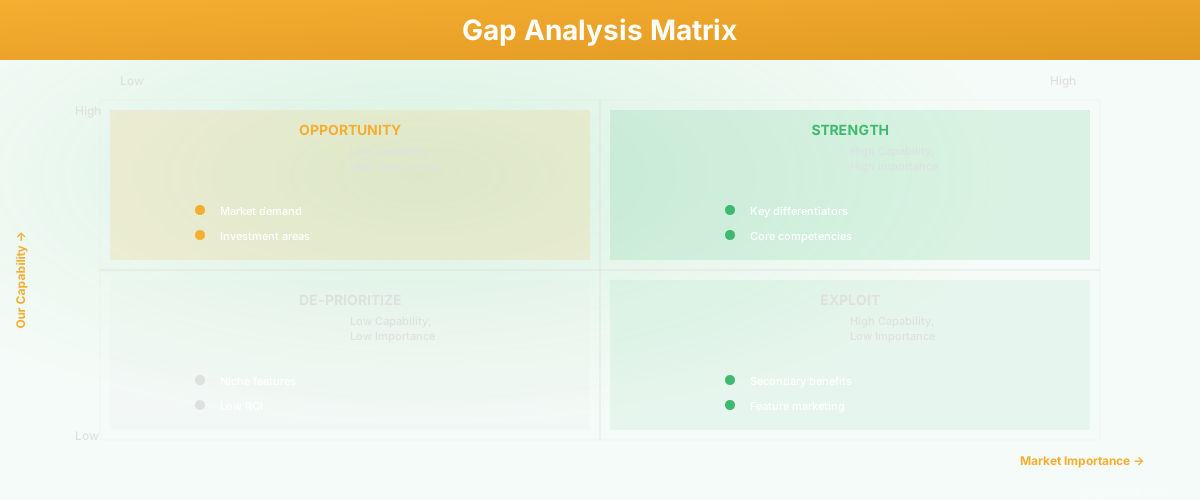
The internal side also reveals hidden capabilities. Many product teams don't have complete visibility into what their own product can do. They've built features that haven't been marketed. They've built infrastructure that could support entirely new product directions. Competitive gap analysis that includes an internal codebase component asks: "What could we build on our existing infrastructure if we invested in it?" The answer often uncovers opportunities competitors would struggle to match because the opportunity depends on an infrastructure investment the competitors haven't made.
Most critically, the internal side prevents costly strategic mistakes. A team commits to a roadmap based on external competitive analysis. Only during planning do they discover that several planned features require the same architectural change. Or that a feature they thought was a small effort is actually a system redesign. Good competitive gap analysis incorporates architectural reality early, before the roadmap is locked.
Consider a B2B SaaS platform providing analytics for customer success teams. The product team does competitive gap analysis against three major competitors: they have real-time alert systems, they have custom dashboard builders, they have integrations with major CRM platforms. The product team's current offerings don't have any of these. The initial conclusion: these are table-stakes features, and the roadmap should include all three.
But that analysis is incomplete. The external gap analysis says "what," not "why" and "at what cost." The product team then does internal gap analysis. They examine their codebase and architecture. They discover: real-time alerts would require moving from a batch processing architecture to event streaming. This is doable but substantial. Custom dashboard builders would require exposing their data model and query APIs, which means cleaning up some inconsistencies in how metrics are defined and calculated. This would take two quarters. CRM integrations exist as one-offs in their codebase without a framework. Scaling integrations would require building that framework first.
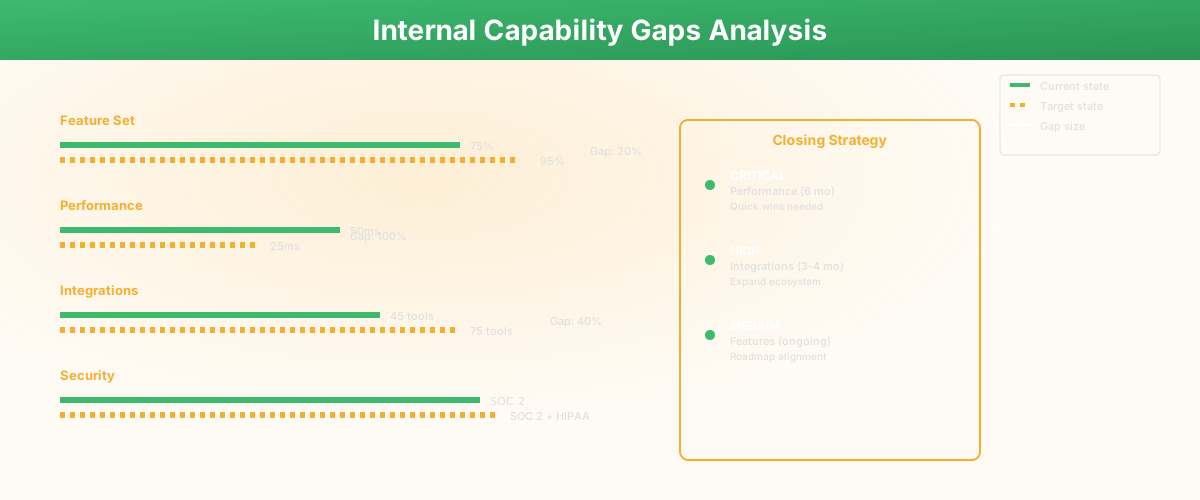
Now the analysis has shifted. Real-time alerts are feasible and valuable. Custom dashboards unlock significant competitive advantage but require foundational work first. Integrations are feasible incrementally, but doing it well requires framework investment that unlocks future integrations faster.
Meanwhile, the team discovers something the external analysis missed: their system has a sophisticated data lineage tracking system that competitors don't expose to users. This could be a differentiation point. Users could understand how metrics are calculated, what data feeds them, and how changes propagate. No competitor has this. This is a capability hiding in the codebase.
Final roadmap: (1) build real-time alerts to close the external gap, (2) clean up the data model inconsistencies to enable custom dashboards, (3) expose data lineage as a differentiation feature that no competitor has, (4) build an integration framework to start closing the integration gap incrementally. This roadmap is strategic, feasible, and reflects both external competitive reality and internal architectural reality.
Without the internal analysis, the team might have committed to all three competitive features in the same quarter, attempted it, and failed. Or they might have built real-time alerts in a way that conflicts with future dashboard building. Or they might have missed the lineage differentiation entirely.
Internal competitive gap analysis requires codebase understanding. The product team needs to know: what capabilities exist in the codebase today that aren't being marketed? What would be hard to build given current architecture? What would require foundational work first? What dependencies exist that mean changes in one area affect others?
The starting point is an inventory of current capabilities. This isn't the marketing feature list. It's the actual technical capabilities that exist in the codebase. Does the product have real-time processing? Batch processing? Stream processing? Can it scale to large datasets? Can it handle custom queries? Can it integrate with external systems? This inventory reveals what's already possible.
The second step is dependency analysis. Are major features tightly coupled so that changing one affects others? Are there architectural constraints that make certain features hard? For example, if custom dashboards require exposing the data model, but the data model has inconsistencies that would confuse users, the work includes data model cleanup before the feature can work well. These dependencies affect roadmap sequencing.
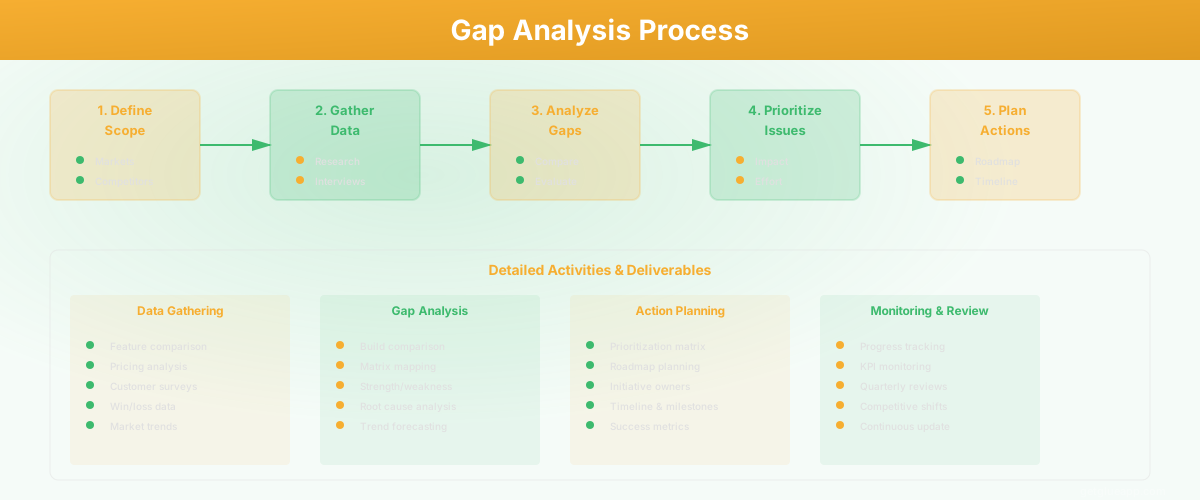
The third step is capability mapping: What would we need to build to support a competitor feature? Not the surface feature, but the infrastructure. Real-time alerts require event streaming. Custom dashboards require a flexible query system and data lineage. These requirements reveal the actual scope of competitive gap closure.
Implementing internal gap analysis usually requires product teams to have access to architectural knowledge. This is where code intelligence matters. Product teams shouldn't need to ask senior engineers to explain the architecture. They should be able to query the codebase: "What are all the places where we process user data? Show me the dependencies between our main subsystems. What changed in the data model in the past year?" With this information accessible, product teams can perform better gap analysis without becoming dependencies of engineering expertise.
Misconception 1: Competitive gap analysis is only a product responsibility. While product teams drive the analysis, it should include engineering perspective. Engineers understand what's hard in the codebase. Without engineering input on feasibility and cost, gap analysis becomes aspirational speculation. The best gap analysis includes both product perspective (what matters to customers and where competitors are winning) and engineering perspective (what's feasible and at what cost).
Misconception 2: The goal of gap analysis is to close all gaps. Some gaps are worth closing. Others aren't. A competitor might have a feature that matters to only 5% of the addressable market. Closing that gap might not be a good investment. Gap analysis should identify which gaps matter most to the business, which are feasible to close, and which offer the best return. Some gaps are intentional ( - ) the product team decided competitors could have that feature, and the team is focusing investments elsewhere.
Misconception 3: If a competitor has a feature, we need to build it. This assumes that features are commodities and parity is the goal. But some features drive switching (customers will switch products for them) and some are just nice-to-haves. Some competitors have features that don't drive customer decisions. Copying them is a waste. Focus on gaps where the feature drives switching or where closing the gap unblocks your own opportunities.
Q: How often should product teams do competitive gap analysis?
A: At minimum, quarterly. More frequent if the competitive landscape is changing quickly. The analysis should include both external (what competitors are shipping) and internal (what's feasible and what's in the roadmap) components. The internal component changes less frequently than the external, so you might do deep internal gap analysis annually and light updates quarterly.
Q: How do you handle situations where a competitor's feature is technically hard to replicate?
A: First, verify that the feature is actually valuable to your customers. If it is, and it's hard to replicate, that's useful information: you have time before it becomes table-stakes. Invest in the foundational work incrementally so you can launch when the feature becomes necessary. If the feature isn't valuable to your customers, document that and move on. Don't invest in features just because competitors have them.
Q: What's the relationship between competitive gap analysis and product differentiation?
A: Gap analysis identifies where competitors are ahead (external gaps) and where you're ahead (capabilities competitors don't have or don't market). Differentiation is built by either closing important gaps faster than competitors or by investing in capabilities they don't have and that you can build faster given your architecture. Good gap analysis reveals both directions for differentiation.
Q: How do you know if your internal gap analysis is accurate?
A: The test is whether it matches reality during planning. If the team committed to a feature based on internal gap analysis saying it's feasible in a quarter, and it takes two quarters, the analysis was wrong. Go back to the architecture, find what was underestimated, and update the analysis. If internal gap analysis is consistently accurate, teams trust it and use it to make better commitments. If it's consistently optimistic or pessimistic, it's not providing value and should be reconsidered.
Keep reading