Glossary
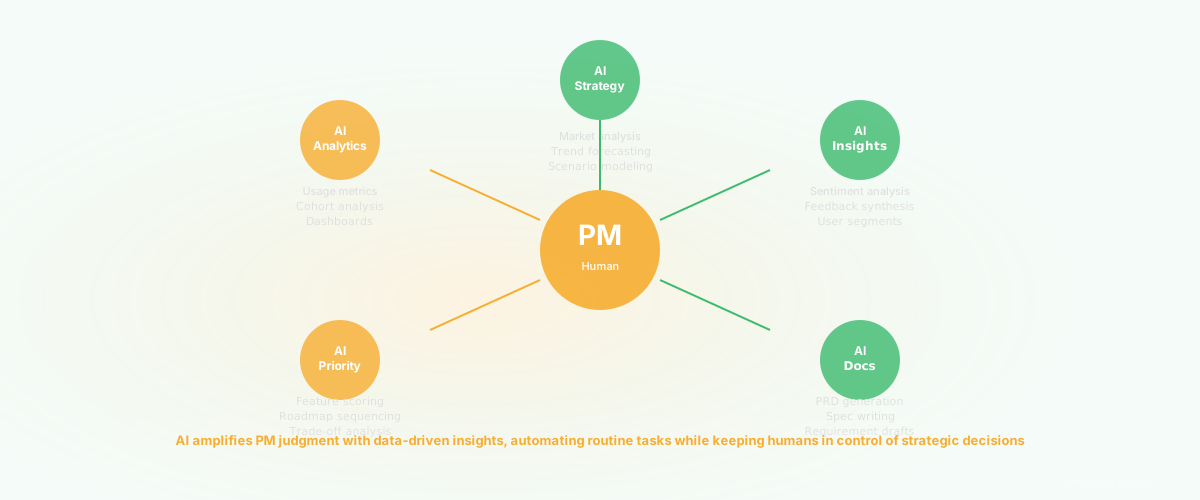
AI product managers assist human PMs by analyzing market data, customer feedback, and competitive intelligence to inform strategy and prioritization decisions.
At Salesken, our product managers were some of the smartest people in the room. But they were making decisions with incomplete information because the codebase was a black box to them.
By Priya Shankar
An AI product manager (APM) is a software system—not a person—that assists product leaders by analyzing market data, user feedback, competitive intelligence, and usage metrics to generate insights, forecast demand, and recommend prioritization decisions. It's a force multiplier for your PM team, not a replacement.
The PM role is inherently information-intensive: synthesizing feedback from 100 customers, analyzing 500 support tickets, understanding competitors, forecasting revenue impact, navigating tradeoffs. Most of this is data compilation. AI PMs automate compilation so human PMs can focus on judgment, strategy, and execution.
An AI PM might surface: "Feature requests for 'real-time collaboration' increased 240% YoY; top 20 customers mention it; three competitors shipped it in Q3; estimated 15% revenue lift; engineering effort is 21 points." Then you, the human PM, decide: Is this aligned with our vision? Can we afford it? What would we defer?
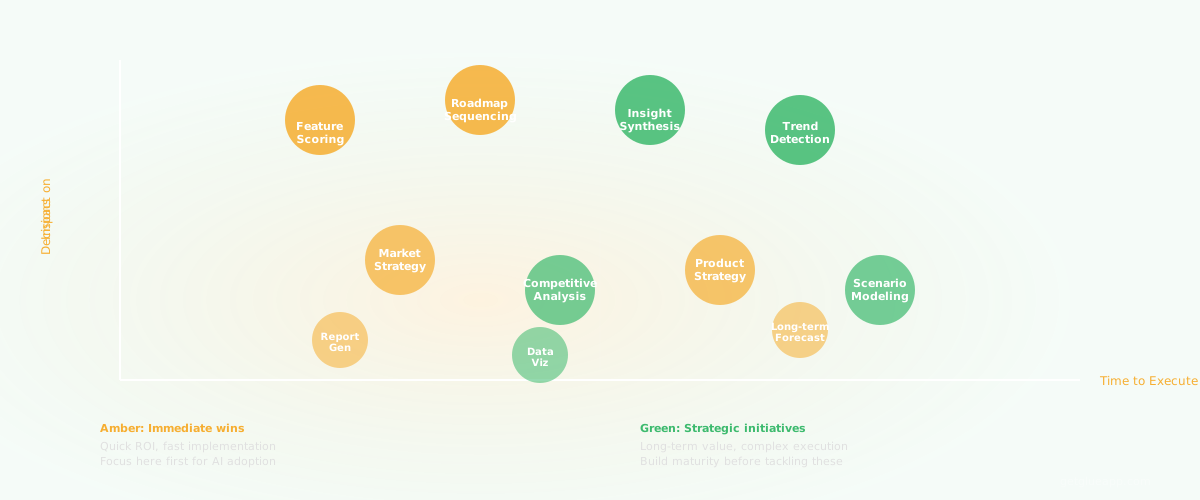
The AI PM handles grunt work: parsing customer feedback for themes, comparing mention frequency across channels, connecting requests to revenue accounts, surfacing contradictions. When deciding between features, the AI PM ensures you're comparing apples to apples.
"AI PMs replace human judgment." They automate information gathering, never judgment. The most important PM work—deciding what to build, saying no, navigating politics, inspiring teams—requires human wisdom.
"AI PMs are unbiased." They inherit biases from training data. A system trained on historical requests will overweight past themes. Humans spot emergent needs the data hasn't captured.
"AI PMs work independently." Not at scale. An AI PM without human oversight will optimize locally while missing strategic context. Humans and AI together > either alone.
Strong PMs spend 20 hours per week on information gathering: reading feedback, analyzing metrics, researching competitors, synthesizing insights. That's 20 hours not spent on strategy, roadmapping, and customer engagement. AI PMs recover that time.
For organizations: scaled PM leverage. One PM with an AI PM system can handle two PMs' work. For individual PMs: freed-up capacity for deeper strategic thinking and customer relationships.
Time savings on analysis: How many hours per week does your PM team spend on information gathering? AI PMs should reduce this 60-70%.
Decision speed: How long from "considering feature X" to "decided to build it"? Faster decisions with better data = AI PM system working.
Strategic clarity: Are roadmaps more intentional and less reactive? PMs freed from gathering can think deeper about strategy.
Team confidence: Do engineering and marketing teams trust PM decisions because they're data-informed? This soft metric matters for execution.
Human PMs can process perhaps 50 customer feedback items per week deeply. An AI PM can process 5,000. It categorizes feedback by theme, sentiment, customer segment, revenue impact, and urgency. Patterns that would take a human weeks to discover emerge in minutes.
AI PMs continuously monitor competitor products, pricing changes, feature launches, and positioning shifts. Instead of quarterly competitive reviews, you get real-time competitive awareness. When a competitor launches a feature your top customers have requested, you know immediately.
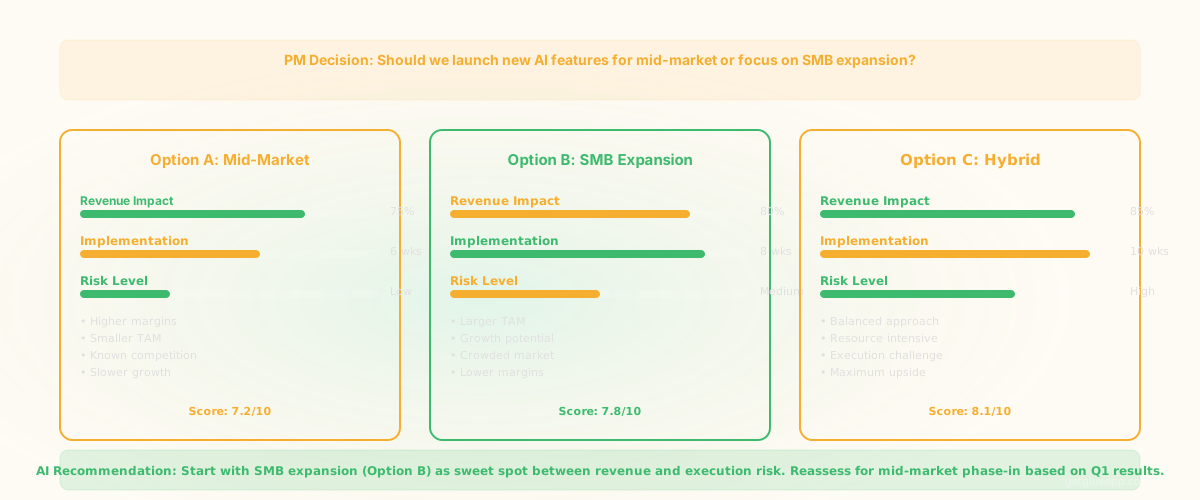
Rather than subjective prioritization (RICE, MoSCoW, gut feel), AI PMs can model multiple prioritization scenarios simultaneously:
Each scenario produces a different roadmap. The human PM chooses which scenario aligns with strategy.
AI PMs that connect to your codebase (like Glue's codebase intelligence) can provide technical context for product decisions. "Adding multi-currency support requires changes to 4 services, has a bus factor of 2, and similar features have historically taken 3-5 weeks." This is more useful than asking an engineer to estimate from memory.
| Layer | What It Does | Example Tools |
|---|---|---|
| Feedback collection | Aggregates customer input | Productboard, Dovetail, Canny |
| Analysis engine | Finds patterns in feedback | AI/LLM-powered analysis |
| Codebase intelligence | Connects product decisions to code | Glue |
| Prioritization | Models trade-offs | RICE frameworks, custom models |
| Roadmap generation | Visualizes plans | Productboard, Linear, Jira |
| Communication | Shares plans with stakeholders | Notion, Confluence, Slack |
Level 1: Assisted PM. AI handles feedback categorization and basic competitive monitoring. The PM still does all analysis and decision-making manually. Most teams are here today.
Level 2: Augmented PM. AI generates prioritization recommendations, creates competitive briefs, and drafts roadmap options. The PM reviews, adjusts, and decides. Leading product teams are reaching this level.
Level 3: Autonomous PM (emerging). AI handles routine product decisions (bug prioritization, minor feature scoping) autonomously while escalating strategic decisions to humans. This level is early-stage and requires high trust in AI systems.
Level 4: Strategic PM Partner (future). AI acts as a strategic thinking partner, challenging assumptions, modeling scenarios, and providing counter-arguments to PM hypotheses. This requires AGI-level reasoning and is years away.
Q: Can we fully automate product management? No. Automation handles information gathering and basic analysis. Strategy, judgment, empathy, org navigation, vision—these stay human.
Q: How do we prevent AI PMs from hallucinating insights? Require source transparency. Good systems show exactly which feedback, metrics, and competitive moves informed a conclusion. If you can't see sources, don't trust it.
Q: What if an AI PM recommends building something contradicting our vision? That's a feature. The AI PM should challenge you. If data strongly suggests customers want something, and you disagree, that's an explicit strategic decision to document.
Q: Can AI PMs help with roadmap communication? Absolutely. They can generate different roadmap narratives for different audiences, forecast dependencies, and help communicate tradeoffs clearly.
Keep reading