Glossary
Code health measures how well a codebase supports ongoing development. Learn why it matters for product velocity.
At Salesken, I started measuring code health after a quarter where our deployment times doubled. The codebase was degrading in ways that weren't visible until I built the right dashboard.
Code health is a measure of how well a codebase supports ongoing development ( - ) how understandable, modifiable, and resilient the code is. Code health is not the same as code quality. A codebase can have high test coverage, pass lint checks, and have no known bugs while still having poor code health. Code health reflects whether engineers can understand the code, change it safely, debug it when it fails, and maintain it over time without each change introducing fragility elsewhere.
Code health directly determines product velocity. A product team with a healthy codebase can make changes quickly, add features safely, and maintain momentum. A product team with an unhealthy codebase makes changes slowly. Every feature addition requires careful navigation around existing fragility. Every bug fix risks introducing a new bug elsewhere. Engineering momentum decreases, estimates increase, and the team spends more time maintaining than building.
Product managers often don't see code health directly, but they feel its effects. A feature that should take two weeks takes six weeks not because the spec changed, but because the codebase doesn't support the change safely. An incident that should have been fixed in an hour takes a day because no one understands the failure mode. Roadmap items get descoped not because they're not valuable, but because the code base doesn't support them without major refactoring. These are code health problems manifesting as business velocity problems.
Code health also determines incident severity and recovery time. An incident in a healthy codebase is usually localized ( - ) the team debugs the specific component that failed. An incident in an unhealthy codebase often spreads because systems are tightly coupled and no one fully understands the dependencies. Recovery takes longer because the failure mode is hidden in complex interactions.
Most critically, code health is a product risk indicator. As code health declines, the organization's ability to respond to market changes, competitive threats, or customer requests declines with it. When code health becomes bad enough, large refactorings become necessary. These are expensive pauses in feature development that could have been prevented by investing in code health incrementally.
Consider two product teams, both building similar features at the same company. Team A works in a codebase with strong code health. Functions are short and focused. Complex logic is documented. Dependencies are explicit and manageable. When Team A needs to add a new feature, they identify the relevant modules, understand how they fit together, and implement the change. Code review catches edge cases. Tests pass. The feature ships in three weeks. The code is maintainable ( - ) when a bug appears two months later, it takes hours to diagnose and fix.
Team B works in a codebase with poor code health. Functions are long and do multiple things. Complex logic is undocumented. Dependencies are implicit ( - ) changing one function breaks others in ways that aren't obvious. When Team B needs to add the same feature, they first spend time understanding what the existing code does. Comments are sparse or misleading. Tests are minimal. They make a change, run tests, and discover that something unrelated broke. They trace through the code to understand why. The feature takes eight weeks. When a bug appears two months later, it takes days to diagnose because multiple parts of the code might be responsible.
The difference is code health. Both teams are competent. Both have similar tools and methodologies. But Team A's codebase supports fast, safe changes. Team B's codebase resists change.
Over time, the difference compounds. Team A continues shipping features on schedule. Team B falls further behind. The organization concludes that Team B needs more hiring or better process. But the actual problem is code health. Hiring more engineers to Team B doesn't improve code health ( - ) it might actually make it worse because new engineers struggle to navigate unhealthy code. Better process can't fix code that's fundamentally difficult to work with.
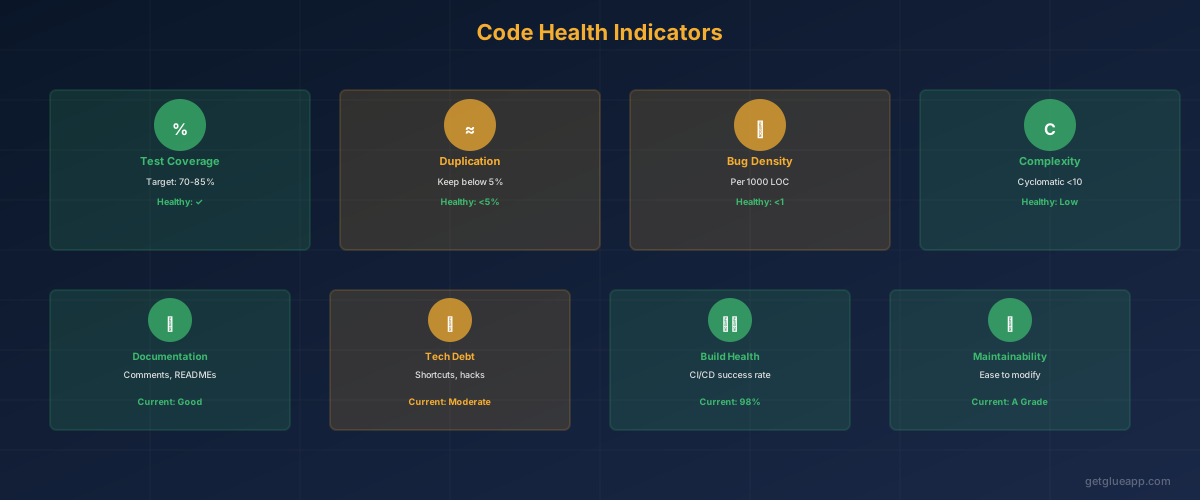
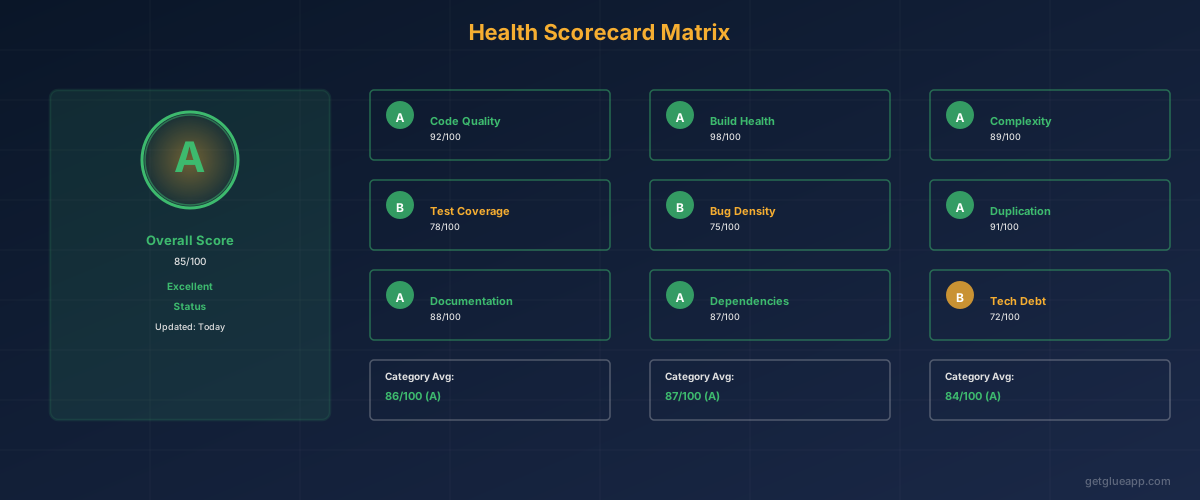
Code health is measured through multiple indicators. Cyclomatic complexity ( - ) how many branches and conditions are in the code ( - ) indicates difficulty of understanding and testing. Functions with complexity above 10 are usually difficult to understand. Modules where all high-complexity functions are concentrated indicate unhealthy localization.
Change failure rate ( - ) how often changes cause bugs or regressions ( - ) is a direct code health indicator. A healthy codebase with good tests should have low change failure rate because changes are isolated. High change failure rate signals that changes break unexpected things, which usually indicates tight coupling or poor understanding.
Time-to-understand-per-module is a practical metric. Take a new engineer or a developer coming back to code after six months. How long does it take them to understand what a module does well enough to make a safe change? If the answer is "days," it's a code health problem. If the answer is "minutes," the module is healthy.
Depth of dependency chains ( - ) how many layers of abstraction or dependencies separate a change from its effects ( - ) predicts change risk. Shallow dependency chains are healthier because the effects of changes are localized. Deep chains mean a change in one place propagates through many layers before the actual effect becomes visible.
Improving code health requires continuous investment. Refactoring is the primary lever ( - ) breaking large functions into smaller, focused ones; simplifying complex conditional logic; extracting dependencies so they're explicit rather than implicit. Refactoring doesn't add features. It makes the codebase easier to work with so features can be added faster and safer later.
Documentation is secondary to refactoring. A comment explaining complex logic is better than no explanation. But the ideal is code that's simple enough that it explains itself. When documentation is needed, that's a signal to refactor.
Misconception 1: We have high test coverage, so our code is healthy. Test coverage ( - ) what percentage of code is executed by tests ( - ) is one signal of code health but not determinative. A codebase can have 85% test coverage and still be unhealthy if the code is difficult to understand, tightly coupled, or resistant to change. Conversely, a codebase can have lower coverage but be healthier if the code that does exist is clear and modifiable. The relationship between coverage and health is not linear. Focus on coverage of critical paths and the healthiness of how those paths are implemented, not on reaching a coverage number.
Misconception 2: Code health is a nice-to-have when we have time. This treats code health as optional refinement rather than essential infrastructure. Low code health directly reduces product velocity and increases costs. The time spent refactoring code now is time not spent on features today. But the time not spent maintaining unhealthy code in the future is much larger. Code health is an investment with a positive return, not an expense. Every feature becomes more expensive to build and maintain in unhealthy code.
Misconception 3: Only junior engineers need to understand code. Senior engineers can work with anything. This misses the core insight of code health. Code health is not about whether someone can figure out what's happening ( - ) it's about how much cognitive load it takes. A senior engineer might understand unhealthy code, but it takes them longer and leaves less mental capacity for actually solving problems. Code health matters more for senior engineers because they should be spending time on hard problems, not on understanding unnecessarily complex code.
Q: How do you prioritize code health improvements when there's always feature work to do?
A: Treat code health as a percentage of engineering capacity, not as something that happens "when we have time." A healthy allocation is 15-25% of engineering time on code health ( - ) refactoring, technical debt paydown, and systematic improvements. This feels slow initially, but features ship faster in healthier codebases, so the net productivity is actually higher. The alternative is spending 100% of capacity on feature work in an increasingly unhealthy codebase, where features actually take longer to build.
Q: What's the relationship between code health and technical debt?
A: Technical debt is a specific form of code health problem. Technical debt is deferred work ( - ) we took a shortcut, and we owe cleanup work later. Code health is broader ( - ) it includes technical debt, but also includes code that was never properly designed, complex code that's hard to understand, tightly coupled systems, and poor architecture. Some code health problems aren't technical debt because the code wasn't a shortcut ( - ) it was just built in a way that's hard to maintain.
Q: How do product teams help improve code health if they're not writing code?
A: Product teams can improve code health by treating velocity on healthy code as a business metric. When a feature takes longer because code health is poor, that's a cost that should be visible to product. By connecting slow feature delivery to code health problems, product teams create organizational incentive to invest in code health. Additionally, product teams can avoid designs that require tight coupling or complex interactions. Good product architecture ( - ) loose coupling, clear dependencies, separation of concerns ( - ) makes good code health easier to achieve.
Keep reading