Glossary
Monitor competitors automatically with AI tools. Learn how to pair competitive intelligence with internal codebase visibility for faster strategic decisions.
At Salesken, we were in a crowded market — three direct competitors, each claiming similar features. Understanding what they actually shipped versus what they marketed was the difference between smart roadmap bets and wasted quarters.
AI competitive analysis is the practice of using artificial intelligence tools to systematically gather, synthesize, and interpret competitive intelligence at scale and frequency that would be impractical manually. This includes monitoring competitor websites and changelogs, aggregating customer reviews and sentiment, tracking feature releases, analyzing job postings for strategic hires, and synthesizing market signals into structured intelligence reports. AI tools can scan dozens of competitors daily and flag material changes in days rather than weeks, creating a continuous, near-real-time competitive picture.
Product teams historically competed on information asymmetry. If you knew what competitors were building before they announced it, you had time to respond. AI competitive analysis democratizes this intelligence, making near-real-time signals available to any team. The competitive advantage shifted from having information to having context. Every product team can now see what competitors built, but few can evaluate what it means for their strategy.
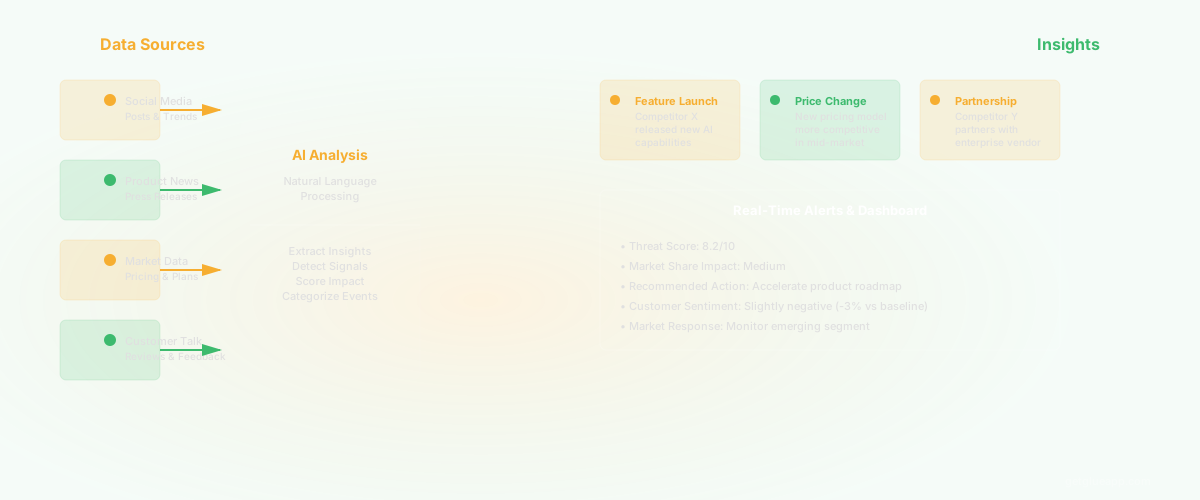
The gap is internal codebase context. An AI tool can tell you "Competitor X launched a recommendation feature," but it can't tell you "our architecture supports recommendations at 1/3 the latency, so we have a performance advantage" or "their data model is similar to ours, so they'll likely face the same scalability constraints in six months." Product managers who understand their own codebase depth, performance characteristics, and architectural constraints can interpret competitive intelligence in context. Teams without this internal visibility often panic at competitive moves or misread the strategic implications.
Engineering managers use AI competitive analysis to flag technical leverage. "Competitors launched real-time features using approach X. Can we do it faster with our current architecture?" This requires understanding your own codebase capabilities. Teams that pair external competitive signals with internal codebase visibility make smarter decisions faster.
A mid-market B2B analytics company uses an AI competitive analysis tool that monitors 12 key competitors. The tool surfaces that Competitor A just released a "real-time data ingestion" feature. The product team has been planning the same feature for Q2 and is concerned about timeline.
Here's where internal context matters:
The team reviews their architecture documentation and codebase. They find that their current data pipeline uses batch processing every 15 minutes. To support real-time ingestion, they need to refactor the pipeline to handle streaming data and update their query layer. They estimate this at 6 weeks of engineering work.
They then research Competitor A's approach by examining their publicly available documentation and GitHub repositories. They discover Competitor A uses a third-party streaming service (AWS Kinesis) and built a thin integration layer. The team realizes Competitor A likely followed a "buy vs. build" approach, outsourcing complexity.
The team's decision: We can either ( - ) build real-time ingestion in-house (6 weeks, gives us full control, differentiates us), or ( - ) integrate a third-party streaming service (2 weeks, matches Competitor A's approach, acceptable for now). They choose option 2 for speed, ship in Q1 instead of Q2, and outpace Competitor A to market despite the competitor launching first.
Without understanding their own architecture and codebase, the team would have panicked at the competitor launch and perhaps made a poor decision ( - ) either delaying their feature launch to build something overly complex or rushing a sub-standard implementation.
Step 1: Define Your Monitoring Set. Identify 8-15 direct competitors ( - ) companies solving the same problem for the same customer. Avoid monitoring everyone in your industry; focus on direct competitors. For each competitor, identify the signals that matter: website changes, feature releases, pricing changes, job postings (hiring for what skills?), customer reviews (what's the sentiment?), funding announcements.
Step 2: Set Up Automated Monitoring. Use an AI competitive intelligence tool to monitor competitor websites, GitHub repositories, API changelogs, job boards, and review sites. Most tools can surface changes within 24-48 hours of occurrence. Create a weekly synthesis report: What changed? What does it mean?
Step 3: Correlate with Your Codebase. When a competitive signal surfaces, the next question is internal: What does this mean for our architecture and roadmap? This requires understanding:
Teams with codebase visibility can answer these questions in hours. Teams without visibility often spend weeks in planning meetings guessing at answers.
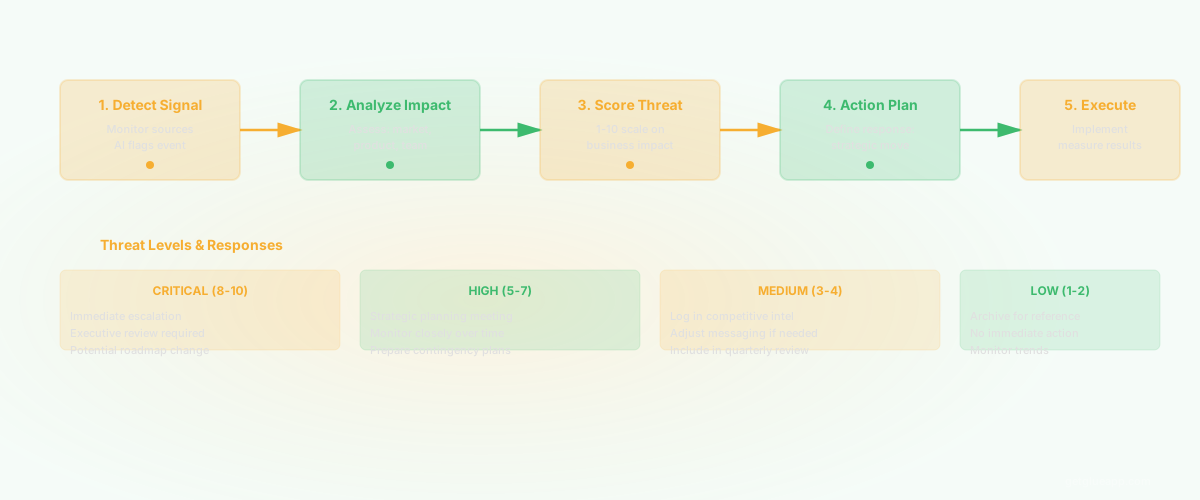
Step 4: Make Faster Decisions. With intelligence + internal context, product teams can decide quickly: Do we need to change our roadmap? Do we have an advantage they'll eventually catch? Should we double-down on our differentiation or match their feature? Fast, context-informed decisions compound into strategic advantage.
Misconception 1: AI competitive analysis tells you what you should build next. Correction - it tells you what competitors have built. Strategic decisions require understanding market timing (did they ship too early?), customer demand (do customers actually want this?), and your differentiation (is this a feature or a commodity?). AI surfaces options; strategy determines direction.
Misconception 2: You can make competitive decisions without understanding your own codebase. Correction - you'll either over-estimate what's difficult ("We can't compete because they have feature X") or under-estimate costs ("We can build this in three weeks like they did"). Understanding your architecture constraints and technical leverage is as important as understanding competitor moves.
Misconception 3: AI competitive analysis is a replacement for customer research. Correction - competitors' feature releases reflect their hypothesis about customer needs, not validated customer demand. Your customers may not care about what competitors launched. Pair external competitive signals with customer conversations to decide what matters.
Q: How often should we review competitive intelligence? Weekly synthesis reports are typical ( - ) enough frequency to catch material changes, not so frequent that noise overwhelms signal. During high-velocity competitive periods (everyone launching new features), increase to twice weekly. Quarterly deep dives to reassess competitive positioning and strategy direction.
Q: A competitor launched a feature we planned for Q3. Should we accelerate? Depends on context. If they shipped a half-baked version and you're planning a superior implementation, accelerating may be premature and waste resources. If they solved a critical customer problem and you're weeks away, accelerating makes sense. The question is not "did they launch first" but "did they launch better." Internal codebase context helps you answer faster.
Q: How do we prevent competitive analysis from paralyzing decision-making? Set decision gates: "We review competitive moves weekly and adjust roadmap only if the move directly blocks a customer commitment or opens a material market opportunity." Random competitive moves shouldn't trigger planning chaos. Use intelligence to inform decisions, not determine them.
Keep reading