Glossary
Learn how agentic engineering intelligence systems autonomously detect codebase signals and propose fixes. Understand the current state, trajectory, and guardrails.
Across three companies — Shiksha Infotech, UshaOm, and Salesken — I've learned that most engineering problems aren't technical. They're visibility problems.
Agentic engineering intelligence refers to AI systems that autonomously take action within codebases based on detected signals, rather than merely answering queries about code. Unlike passive code search tools or code generation assistants that respond to user prompts, agentic systems initiate actions - opening pull requests, creating tickets, running diagnostics, proposing refactors - without waiting for explicit instructions. They function as autonomous agents that observe codebase signals, reason about implications, and execute remedial actions within defined guardrails.
Agentic systems remove the friction between signal detection and action. Today, teams detect problems through multiple channels: CI/CD failures, monitoring alerts, code analysis reports, team discussions. But detection and remediation are disconnected. Someone sees a problem, triages it, creates a ticket, waits for engineering bandwidth, then work begins.
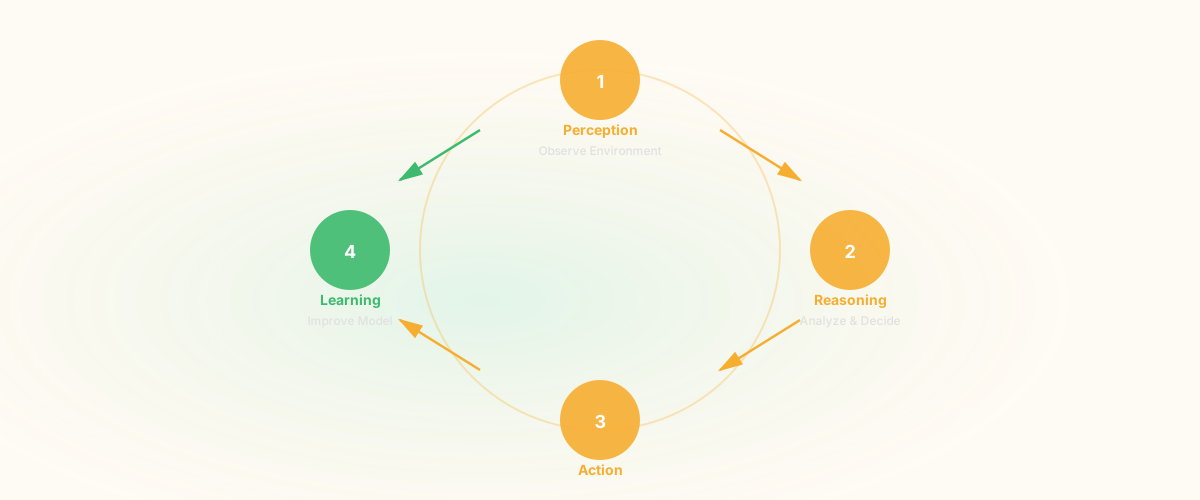
Agentic engineering intelligence compresses this timeline. When an automated system detects that a critical module has exceeding cyclomatic complexity, it can immediately propose a refactoring PR. When it detects that a service is missing test coverage in a critical path, it can surface that as a PR proposal with test scaffolding. When it identifies that code quality has deteriorated in a system, it can flag it, route it to the owning team, and track remediation.
This matters for product velocity. The fastest engineering teams don't just react to problems - they have systems that respond to problems automatically. Agentic systems encode this responsiveness. They don't replace engineering judgment. They remove the latency between seeing a problem and starting to fix it.
For product and engineering leaders, agentic systems create visibility into system health and engineering practices. Instead of quarterly code quality reviews, you get continuous signals about what's breaking and what's being fixed. Instead of relying on engineers to report tribal knowledge concentration, you can see it directly and prompt knowledge transfer automatically.
Consider a concrete scenario: a system that monitors code complexity in production services.
Without agentic intelligence:
PaymentProcessor.validateTransaction() grew from 45 to 78 cyclomatic complexity.With agentic intelligence:
The same work gets done, but the latency between detection and action drops from weeks or months to hours. The system doesn't decide - it proposes. Engineers decide.
Agentic systems handle other workflows similarly:
Testing gaps: System detects that a critical path has below-target coverage. It auto-generates test scaffolding as a PR. Engineers fill in the test logic.
Technical debt: System flags mounting complexity in a service. It suggests refactoring PRs with specific proposed structure changes.
Dependency issues: System detects that a service depends on a deprecated system. It creates a ticket, routes it to both teams, and tracks the deprecation migration.
Ownership clarity: System detects that code is being changed by three different teams with no explicit ownership. It flags it and suggests establishing ownership.
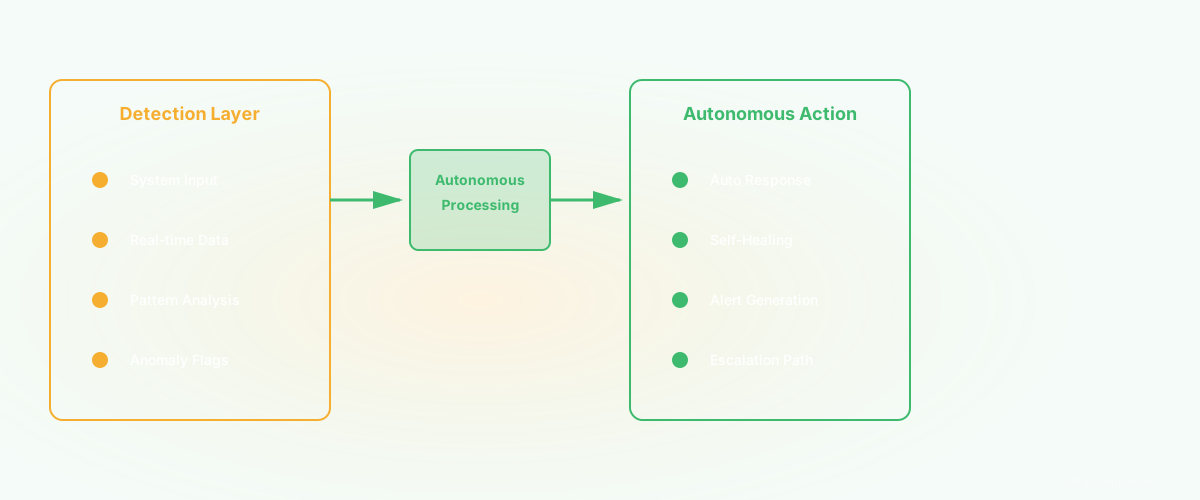
None of these actions are taken without context. All of them can be reviewed and refined by engineers. The point: action doesn't require humans to notice the problem and manually trigger response. The system triggers the response based on signals.
Agentic engineering intelligence exists today but is nascent. Most systems currently handle:
In the next 2 - 3 years, expect:

Autonomous action in a codebase creates risks that need careful handling:
Scope control: Agentic systems must have clear boundaries. They should not make breaking changes without explicit approval gates. They should not touch critical paths without safeguards. Systems should be limited to specific domains (testing, complexity reduction, deprecation management) rather than having general autonomy.
Quality assurance: Auto-generated code is only as good as the generation logic. Systems that create PRs must be held to high standards. Code review gates, test requirements, and human approval for certain classes of changes are non-negotiable.
Transparency: When an agentic system takes action, that action must be visible and explainable. Engineers must be able to understand why a PR was created, what the system is trying to accomplish, and whether they agree with the approach.
Reversal and rollback: Systems should be designed so that agentic actions can be rolled back. If the system created a PR that seemed good but introduced a bug, reversal should be straightforward.
The safest approach: start with read-only agentic systems (detection and reporting). Advance to proposal systems (create PRs but require review and approval). Only move to full autonomy (auto-merge under specific conditions) after extensive validation.
Agentic systems are just AI code generation: False. Code generation tools like Copilot respond to prompts. Agentic systems initiate action based on detected signals. They're fundamentally different.
Agentic systems will create low-quality code: Not necessarily. Quality depends on the specificity of the task and the quality of the generation logic. An agentic system that proposes complexity reduction PRs within defined domains can be highly effective. An agentic system trying to build features from scratch will struggle.
Agentic systems remove the need for engineers to think carefully about code: False. They automate routine response to detected problems, but they don't replace architectural thinking or design judgment. Engineers still review, refine, and decide whether to accept agentic proposals.
Q: How do agentic systems differ from continuous integration (CI) systems?
CI systems run tests and catch bugs. Agentic systems detect signals and propose fixes. Related but different: CI tells you what's broken. Agentic systems tell you what's broken and suggest how to fix it.
Q: What happens when an agentic system's proposal is bad?
It gets reviewed and refined or rejected. The point isn't that agentic proposals are always correct - it's that they eliminate the lag between detecting a problem and starting to address it. Bad proposals get caught in review.
Q: Can these systems work in regulated or safety-critical industries?
Yes, but with more conservative guardrails. In medical or financial systems, agentic actions might be limited to proposals and suggestions, with mandatory human review before any code change. The principle remains: detect problems faster, propose solutions, let experts decide.
Keep reading