
Technical Debt Reduction Playbook: How to Actually Pay It Down
Technical debt reduction is the systematic process of paying down accumulated software quality issues through continuous, measured remediation rather than periodic "debt sprints." The most effective approach allocates 20–30% of engineering capacity to ongoing debt work — below 15% debt accumulates faster than it's resolved, above 40% feature velocity suffers competitively. Emergency debt (e.g., an auth module with 40% change failure rate and 30+ annual incidents) warrants focused 1–2 sprint interventions, but teams requiring more than one emergency sprint per year have abandoned continuous practice for crisis mode. Success is measured by deployment frequency improvement, change failure rate reduction, and 30–50% drops in time-to-first-change for new engineers.
At Salesken, we had a 'tech debt' label in Jira with 200+ tickets. When our board asked how much technical debt we had, I couldn't give them a number. That experience taught me that unmeasured debt is invisible debt.
Most debt reduction initiatives fail. Not because the goal is wrong. Because the approach is broken.
The typical pattern: leadership gets concerned about debt. Someone spends a month auditing the codebase. A report comes out: "We need to refactor the auth module, the API layer is too tightly coupled, the database schema is a mess." The team gets excited about fixing things. Leadership approves a "debt quarter" - one quarter where the team focuses on debt instead of features.
Month one: good progress. The team refactors. Test coverage goes up. Code complexity goes down. Month two: "Hey, we need to ship that customer feature or we'll lose the deal." Month three: "Forget debt week, we're shipping." The initiative dies, but the debt is still there. Now the team is demoralized because they tried and it didn't matter.
I've led three debt reduction programs that actually worked. The ones that failed followed the above pattern. The ones that worked followed a different approach entirely.
Why the "Debt Quarter" Approach Fails

First: it's contextually impossible. For a quarter to be truly debt-focused, you need the organization to say "we're shipping no features, no customer work, no revenue-driving projects" for 13 weeks. That's a hard sell when competitors aren't doing it. Salespeople hate it. Business stakeholders hate it. Three weeks in, pressure builds.
Second: it encourages binary thinking. Either you're shipping features or you're paying debt. That's false. You can do both, and you should. A team that spends 80% of their time on features and 20% on debt does better work than a team split 50 - 50. The debt work is contextualized, tied to the systems they're actively modifying, and it feels less like tax.
Third: it assumes debt is an emergency that needs emergency treatment. Sometimes it is. But most debt is chronic, not acute. Chronic problems need chronic management, not emergency quarters.
The Playbook That Works: Continuous Debt Practice
The principle is this: always leave the campsite cleaner than you found it. When you're shipping a feature, you touch certain systems. While you're in there, you make small improvements. Not a full rewrite. Small, targeted improvements that make the next person's job easier.
You're writing a feature in the payment module. While you're in there, you notice the retry logic is hard to follow. You refactor it from 40 lines of spaghetti to 15 lines of clear logic. You add tests. Now change failure rate in that function drops from 8% to 2%. The feature ships on time. The module is slightly healthier. No "debt quarter" needed.
This is the strangler fig approach to technical debt. You're slowly replacing the brittle system with a healthier one, without needing to rip it all out. Each small improvement is low risk. The cumulative effect is massive.
How to Implement This
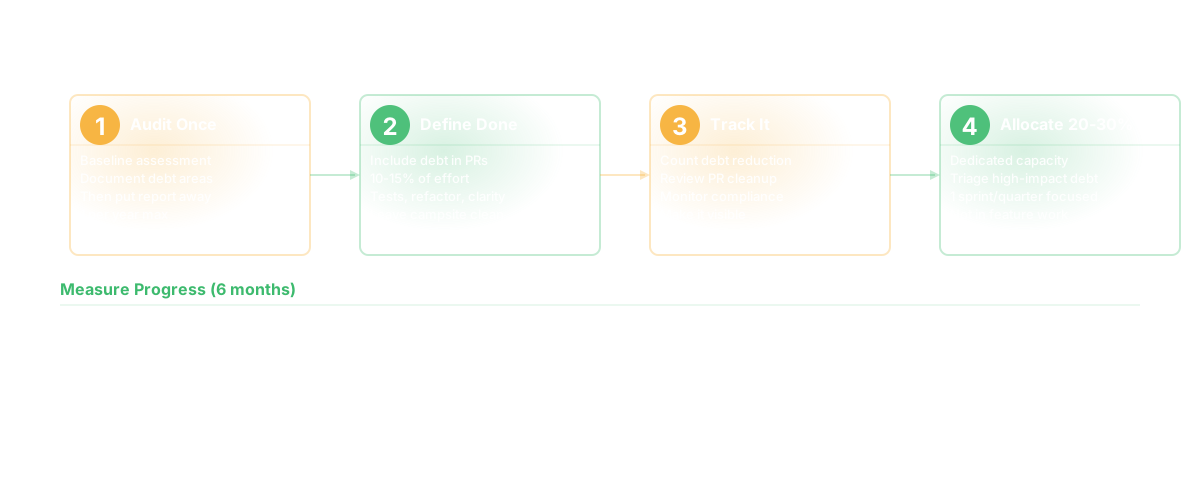
First, audit once and then don't. Do a baseline technical debt assessment. Find the modules with structural debt, operational debt, and velocity debt. Document it. Then put the report away. You're not doing another full audit for a year.
Second, define "done" for code changes to include a small debt component. When you close a PR, you're not just shipping the feature. You're also expected to leave something cleaner. Add a test. Refactor a tangled function. Extract a repeated pattern into a shared utility. Make a comment clearer. None of this should take more than 10 - 15% of the PR effort.
Third, track it. Count how much debt reduction you're doing. If you review PRs touching the payment module and none of them included cleanup - refactoring, testing improvements, clarity changes - that's a problem. The "leave the campsite clean" norm isn't being followed.
Fourth, allocate 20 - 30% of sprint capacity explicitly to debt. This is the triage work. Not just the cleanup that happens within features, but dedicated time for the debt that nobody's touching in features. This is where you tackle the modules that are causing high incident rates or low velocity, even though nobody's shipping features there. Once a quarter, spend a full sprint on structured debt reduction. Target the modules with the worst operational signals.
The Real Conversation With Non-Technical Leadership
Most engineering leaders can't get buy-in for debt reduction from leadership because they're having the wrong conversation.
Bad conversation:
- Engineer: "We need to refactor the code to make it cleaner."
- Leadership: "How does that help us hit our Q2 numbers?"
- Engineer: "Uh... we'll ship features faster? Eventually?"
- Leadership: "Let's focus on features first, debt later."
Good conversation:
- Engineer: "Our payment module has a 23% change failure rate. That means 1 in 4 changes to that module introduce a bug. We've had 18 production incidents this year from that module. Each one costs us on-call time, customer support escalations, and engineering cycles. Here's the business math: fixing that module costs us 8 engineering weeks. That prevents approximately 4 - 6 incidents next year. We also ship payment features slower because engineers are cautious. Fixing the debt in that module will improve our payment feature velocity by an estimated 30% - that's 2 - 3 more features shipped this year."
The second conversation is tied to outcomes: incidents, velocity, shipping speed. That matters to leadership. That gets budget.
Here's the template: "This module has a [X]% change failure rate and [Y] incidents last quarter. Our analysis shows it's slowing down feature velocity in [area] by [Z]%. Fixing this requires [time]. The ROI: [incident reduction] and [velocity improvement]."
Get specific. Quantify. Connect to outcomes leadership cares about - shipping speed, incident rate, revenue impact.
The Implementation Pattern That Avoids Risk
When you're doing continuous debt reduction, small improvements, there's low risk. But some debt is bigger. A module that's 5,000 lines and needs a full refactor. How do you do that without breaking everything?
The strangler fig pattern. You don't replace the old system with a new one. You build a new one alongside, slowly migrate traffic or calls to the new one, and retire the old one. It takes longer but it's low risk.

Example from a company I worked with: their user authentication was a 3,000-line monolith in their Rails app. High bus factor - one person understood it. Regular bugs. Slow feature velocity. Instead of rewriting it, they built a new authentication service alongside the old one. For three months, both ran in parallel. New code used the service. Old code used the monolith. Gradually, they migrated. After six months, the old system had zero users and was deleted. Zero outages. Zero crises. Just slow, methodical migration.
The Cadence That Works
Monday planning: "Which debt items are we tackling this sprint?" Pick 2 - 3. Usually these align with features: "We're shipping the payment refactor feature and while we're in that code, we're fixing the retry logic debt and adding tests to the failure path."
Weekly standup: "How's the debt work going?" Not as a checkbox, but as a genuine question. The goal is to keep debt work visible and on track.
Retrospective: "What debt did we actually reduce? What debt did we discover? What's our next target?" This becomes part of your sprint narrative.
Monthly: review your debt metrics. Is structural complexity going down? Is change failure rate improving in targeted modules? Is new engineer ramp time improving? If metrics aren't improving, you're not reducing debt fast enough or you're targeting the wrong debt.
The Measurement That Proves It Works
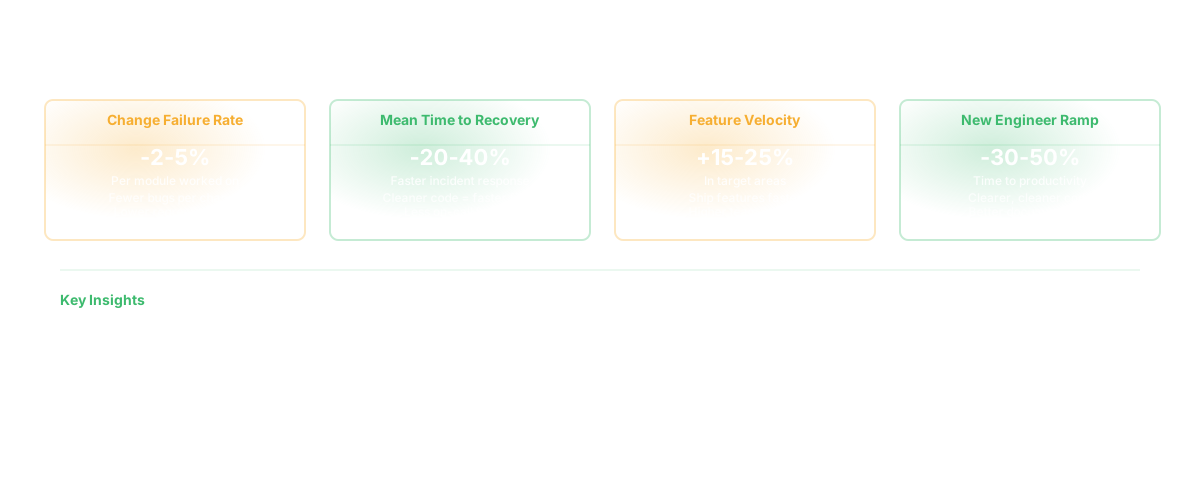
Track these four metrics over six months of continuous debt practice:
- Change failure rate by module - should drop 2 - 5% per module worked on
- Mean time to recovery for incidents in target modules - should drop 20 - 40%
- Feature velocity in target areas - should improve 15 - 25%
- Time for new engineers to make changes in target areas - should drop 30 - 50%
If you're seeing movement on these, the approach is working. If metrics are flat after three months, you're either targeting the wrong debt or you're not actually focusing on it.
When Debt Is an Emergency
Sometimes debt is so bad that continuous practice isn't enough. An auth module with 40% change failure rate and 30+ incidents a year. A database schema that's blocking critical features. That's emergency debt.
For emergency debt, you do allocate a focused sprint or two. But it's focused - just that module, just that problem. And you come back to continuous practice afterward. One emergency sprint per year is reasonable. Three or more means you've given up on the continuous practice and you're in constant crisis mode.
Frequently Asked Questions
Q: What if leadership won't support any debt reduction?
A: Frame it as an investment in the metrics they care about — DORA metrics like deployment frequency and change failure rate make the case concrete. "If we don't reduce this debt, we're looking at 30–40% velocity loss next year." Make it about risk and ROI.
Q: How much time should we spend on debt vs. features?
A: 20–30% is the sweet spot. Below 15% and you'll see debt accumulate — track it with code quality metrics. Above 40% and you're not shipping enough features to stay competitive. The ratio depends on your debt level — if you're starting from a heavily indebted position, 30% might not be enough. But that's temporary, not permanent.
Q: Can debt reduction be done outside of feature work?
A: Yes, but it's harder. Engineers get bored working on code they didn't write and isn't solving customer problems. The most sustainable approach is making debt reduction a normal part of feature work - you touch code, you improve it. But you do need some dedicated time for the high-value debt that nobody's touching in features.
Related Reading
- Technical Debt: The Complete Guide for Engineering Leaders
- Code Refactoring: The Complete Guide to Improving Your Codebase
- DORA Metrics: The Complete Guide for Engineering Leaders
- Software Productivity: What It Really Means and How to Measure It
- Code Quality Metrics: What Actually Matters
- Cycle Time: Definition, Formula, and Why It Matters