
Cursor and Copilot Don't Reduce Technical Debt - Here's What Does
Cursor and GitHub Copilot accelerate writing new code but do not reduce technical debt—they scale existing patterns, including bad ones, making architectural problems worse 3–4x faster than manual coding. Reducing technical debt requires intentional refactoring with architectural decision records (ADRs), explicit debt measurement (cyclomatic complexity, test coverage, hot-spot analysis), and deliberate allocation of AI-generated velocity gains toward quality improvement rather than pure feature throughput.
At Salesken, we adopted Copilot early. The gains were real for boilerplate, but it never helped us understand our own codebase better or make better architectural decisions.
I need to be direct about this: AI coding assistants don't help with technical debt. They make it worse.
This is the thing people don't want to hear. GitHub Copilot and Cursor are genuinely useful tools. They make writing new code faster. But technical debt isn't "code that needs to be written faster." Technical debt is "code whose structure makes change harder." Those are opposite problems.
Debt reduction requires intentional refactoring. That means changing the structure of existing code, not generating more code. AI tools are phenomenal at generating new code. They're useless at refactoring.
In fact, they're counterproductive. Here's why.
How AI Scaling Makes Debt Worse
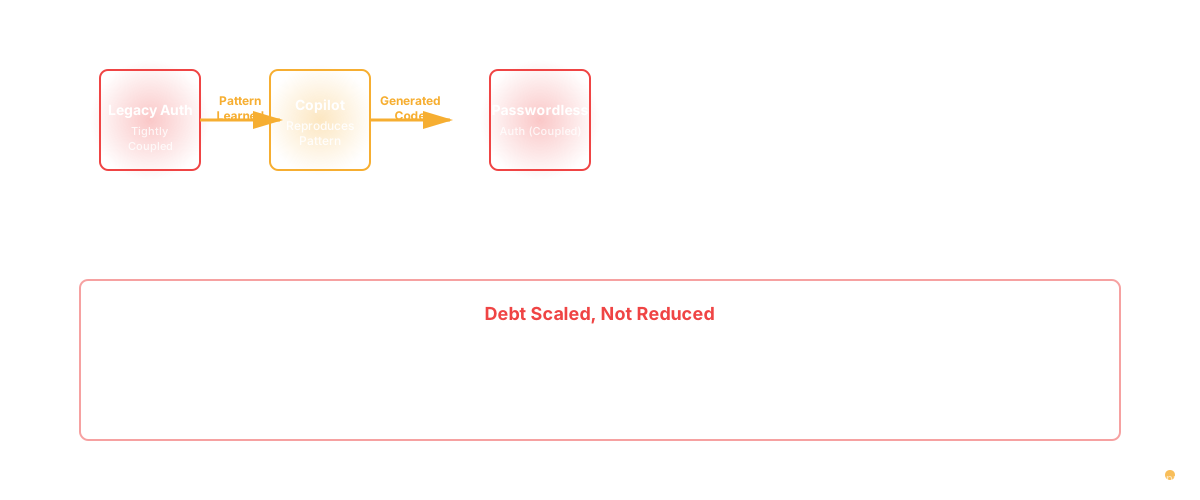
AI coding assistants generate code based on patterns in the existing codebase. If your codebase has messy patterns, the AI generates more of those patterns. It learns from your code and reproduces it at scale.
Let me show you what this looks like:
You have a legacy authentication system. It's coupled to the user service, which is coupled to the database layer, which is coupled directly to the API handlers. It works, but it's a mess. Changing it is hard because everything is interconnected.
Your PM asks for "passwordless authentication." You hand this to your junior engineer who opens it in Copilot. Copilot looks at the existing auth code ( - ) sees the tight coupling pattern ( - ) and generates new passwordless auth code that follows the same pattern. Now you have two coupled authentication systems instead of one.
The code works. It ships. It gets reviewed and deployed. But you've just reproduced the original architecture problem. You've scaled the debt.
This happens because Copilot doesn't understand what your system is supposed to become. It only understands what your system currently is. It's a pattern recognition machine. Bad patterns get reproduced faster than humans can make them.
What Actually Reduces Debt
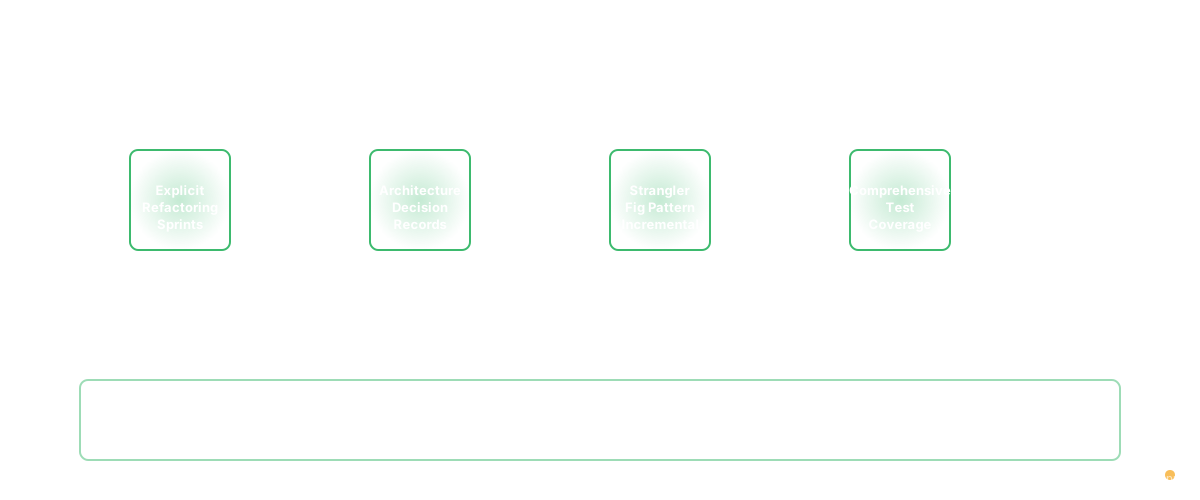
Real debt reduction requires four things that AI can't do. None of them are about generating code.
First: Explicit refactoring sprints with clear scope. You decide: "We're going to decouple authentication from the user service. This will take one sprint. Here's the plan: (1) create an auth service, (2) move auth logic there, (3) create an interface between services, (4) test everything, (5) remove old auth code."
This requires a human making an architectural decision and seeing it through. You can't ask Copilot to "decouple authentication." You can ask it to "write the auth service following this interface" ( - ) that's useful. But the decision to decouple, the design of the interface, the strategy for migration ( - ) that's human work.
Most teams don't do explicit refactoring sprints because they feel like debt. Velocity goes down. Features don't ship. But if you never refactor, debt compounds. Coordinated refactoring is how you reset.
Second: Architectural Decision Records that guide future development. An ADR is a document that says: "We decided to decouple authentication from the user service. Here's why. Here's what that means for how you write code. Here's the pattern to follow."
Once you've done the refactoring work, you write this down. Then when the next person (or the same person six months later) needs to add something to authentication, the ADR is there. It guides them toward the new pattern, not the old one.
Copilot still doesn't know about the ADR. But if you're explicit in your code comments ( - ) "Follow the pattern in docs/adr-001-auth-decoupling.md" ( - ) then at least the human reviewing the code can check it.
Third: Strangler fig pattern for incremental modernization. You can't always do big refactoring. Sometimes you need to refactor while the system is live and handling traffic. The strangler fig pattern lets you do that.
The pattern: (1) build the new thing alongside the old thing, (2) gradually migrate traffic to the new thing, (3) when the old thing has zero traffic, remove it. This is how Airbnb migrated from Airbnb.com to Next.js. This is how Shopify has modernized their architecture incrementally.
The beauty of strangler fig is that it's small, incremental changes. But it requires someone to design the migration strategy. Copilot can write the new code. But it can't design the strategy, manage the cutover, or handle the edge cases.
Fourth: Test coverage that makes refactoring safe. Before you refactor, you need tests. If you don't have tests, the first thing you do is write them for the code you're about to change. This takes time. It feels like overhead.
But it's the only thing that makes refactoring safe. Once you have test coverage, you can refactor and know you haven't broken anything. Without it, you're flying blind.
Copilot can write tests. It's actually pretty good at it. This is one place where AI tools genuinely help with debt reduction ( - ) they make writing tests faster. But you still need to decide to write the tests, and you need to review them to make sure they actually cover what matters.
Where AI Tools Actually Help
AI tools don't reduce debt, but they do help with debt-adjacent work:
Writing tests for untested code. If you have a legacy function with no tests, Copilot can generate tests based on the function signature and behavior. You review them and decide what additional tests matter. This is genuinely useful.
Generating migration scripts. If you're refactoring the database schema, Copilot can generate migration code based on the old schema and the new schema. It can't design the migration strategy, but it can write the script.
Documenting existing code. Copilot can generate docstrings and comments that explain what existing code does. This is useful for understanding code before you refactor it. It's not a substitute for proper documentation, but it's better than nothing.
Prototyping new patterns. Once you've decided on a new pattern (decoupled services, new error handling approach, etc.), Copilot can generate example implementations. You use these as templates for actual refactoring.
The Honest Take
If you're evaluating whether Copilot helps with technical debt, here's the answer: it doesn't. If your argument for Copilot is "it will help us manage technical debt," that's not a real argument.
The real argument for Copilot is: "It will make us faster at writing new code, which gives us margin to invest in intentional refactoring." That's true. You get a velocity boost. You should invest part of that boost in addressing debt.
But you won't do it automatically. Velocity boost plus distraction is just faster delivery of bad code. Velocity boost plus deliberate refactoring sprints is how you improve. You have to choose.
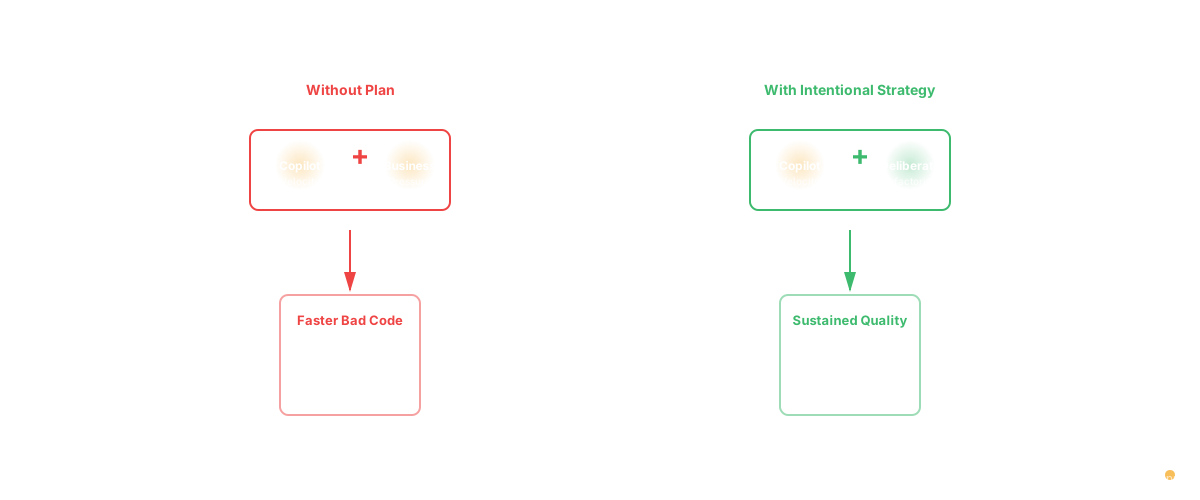
The teams that successfully manage debt use Copilot the way they use any tool: as something that gives them capacity, which they then allocate to things that matter. They write ADRs. They do explicit refactoring. They maintain test coverage. They measure debt and track whether it's improving.
They don't use Copilot as a magic fix for architectural problems. Nothing is.
Frequently Asked Questions
Q: Should we not use Copilot because it scales bad patterns?
No. Use it. But be intentional about it. Use it to accelerate new code, and invest the velocity boost in refactoring. The question isn't "should we use AI tools?" It's "do we have a plan for intentional refactoring?"
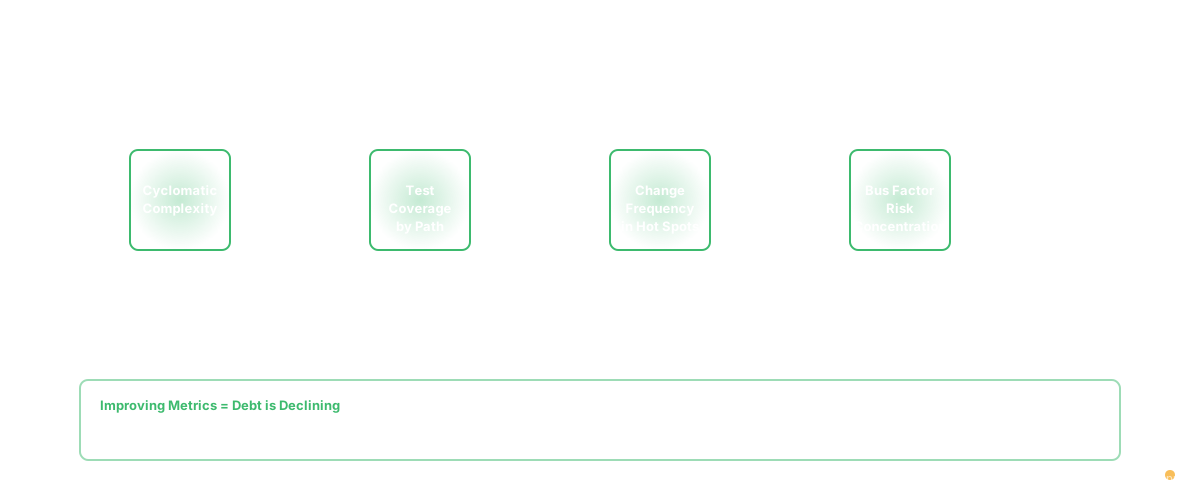
Q: How do we know if our debt is getting better or worse?
Measure: cyclomatic complexity of critical modules, test coverage by critical path, change frequency in hot spots, and bus factor concentration. Track these quarterly alongside DORA metrics — especially change failure rate. If they're improving, you're ahead of debt. If they're declining, you need more refactoring.
Q: Can we ask Copilot to refactor for us?
Not really. You can ask it to generate alternative implementations or suggest refactoring approaches, but you still need to decide on the strategy, review the changes, and make sure the new code works. It's a tool for implementing refactoring, not planning it.
Related Reading
- AI Code Assistant vs Codebase Intelligence: Why Agentic Coding Changes Everything
- AI Agents for Engineering Teams: From Copilot to Autonomous Ops
- AI for CTOs: The Agent Stack You Need in 2026
- Engineering Copilot vs Agent: Why Autocomplete Isn't Enough
- Context Engineering for AI Agents: Why RAG Alone Isn't Enough
- GitHub Copilot Metrics: How to Measure AI Coding Assistant ROI