
At UshaOm, sprint planning took three hours every Monday. By Wednesday, the plan was already wrong. At Salesken, I started measuring why — and the answer was always the same: bad estimates built on incomplete information.
By Vaibhav Verma
The best sprint planning tools for agile engineering teams in 2026 include Jira, Linear, Shortcut, and Glue — but the tool matters less than fixing the underlying process. Most sprint planning fails because estimates are built on incomplete information: engineers don't know how complex a codebase area really is, what dependencies exist, or how fragile the code is. The teams that plan effectively replace gut-feel estimation with data-driven approaches using historical cycle time, codebase complexity signals, and dependency mapping.
It's Wednesday morning. Your team is ninety minutes into sprint planning. The PM is presenting the next feature. The tech lead squints at it, does some mental math, and says "probably an eight." Another engineer disagrees: "that touches the notification service, which is a mess. I'd say thirteen." A third person says "five - we did something similar last quarter."
Three engineers. Three estimates. A 2.6x spread. And this is the process your entire delivery timeline is built on.
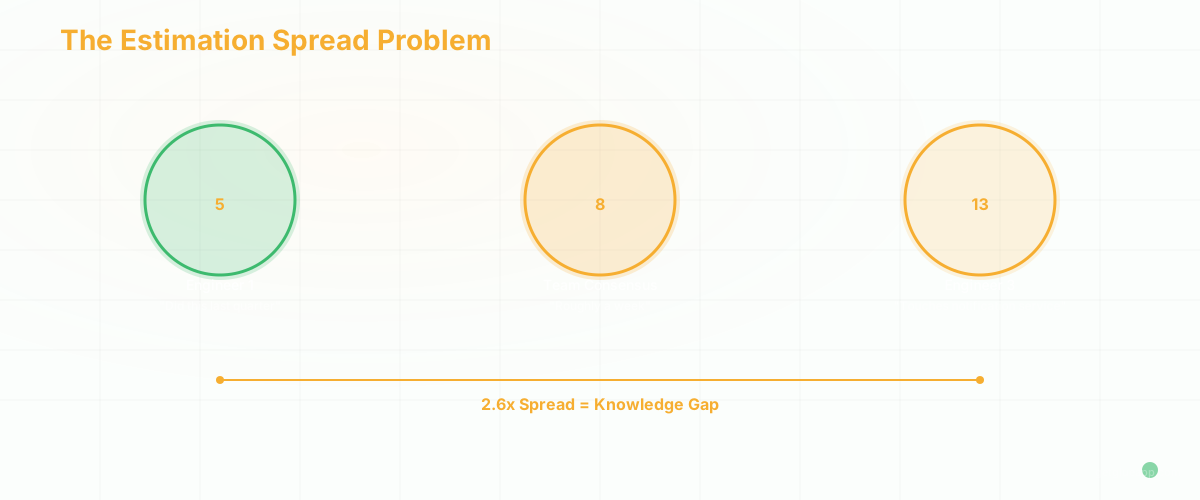
Sprint planning, as practiced by most teams, is estimation theater. It creates an illusion of predictability by dressing guesses up in a numerical system. And the downstream effects are corrosive: padded estimates, missed commitments, eroded trust between product and engineering, and a slow cultural drift toward treating plans as fiction.
I've run sprint planning at four companies. I've watched it work occasionally and fail repeatedly. The failure pattern is consistent enough that I think the problem is structural, not procedural.
The Estimation Theater Problem
Story points were supposed to abstract away time. "Don't estimate in hours," the Agile coaches said. "Estimate in relative complexity." The theory was sound: humans are bad at absolute estimates but reasonable at relative ones. Is this bigger or smaller than that?
In practice, story points became hours wearing a costume. An "eight" means "about a week." A "three" means "a day or two." Everyone knows this. Nobody says it out loud because admitting it would collapse the abstraction.
And even as disguised hours, the estimates are wrong. A 2018 study by Pichler and colleagues found that software estimates are wrong by 25-50% on average, with a systematic bias toward underestimation. That finding has been replicated consistently. Teams underestimate because they estimate the happy path - the implementation they can see - and ignore the work they can't see: edge cases, integration complexity, testing, code review cycles, and the inevitable discovery that the system doesn't work the way they assumed.
The spread in estimates during planning poker isn't noise. It's signal. When one engineer says five and another says thirteen, they're not disagreeing about the feature. They're revealing that they have different models of the system. One of them knows about the notification service complexity. The other doesn't. The estimation gap is a knowledge gap.
And the standard response - discuss until consensus - doesn't solve the knowledge gap. It resolves the number while leaving the underlying misunderstanding intact. The team agrees on eight. They start building. Two days in, they discover the notification service problem. The real estimate was thirteen. The sprint plan is fiction.
Why This Happens: The Visibility Root Cause
Strip away the process, and sprint planning fails for one reason: the people estimating work cannot fully see the system they're estimating against.
An engineer estimating a feature is doing a mental simulation: "I'd need to modify this service, add a database column, update the API, write tests, and get it through review." But that simulation is limited by what they know about the codebase. If they haven't worked on the notification service, they don't know it's a mess. If they don't know about the edge case from the Acme migration, they don't account for it.
This is why estimation accuracy correlates almost perfectly with codebase familiarity. Engineers who've worked on a system for two years estimate well. Engineers who joined three months ago estimate poorly. Not because they're less skilled - because they have less visibility into the system they're estimating against.
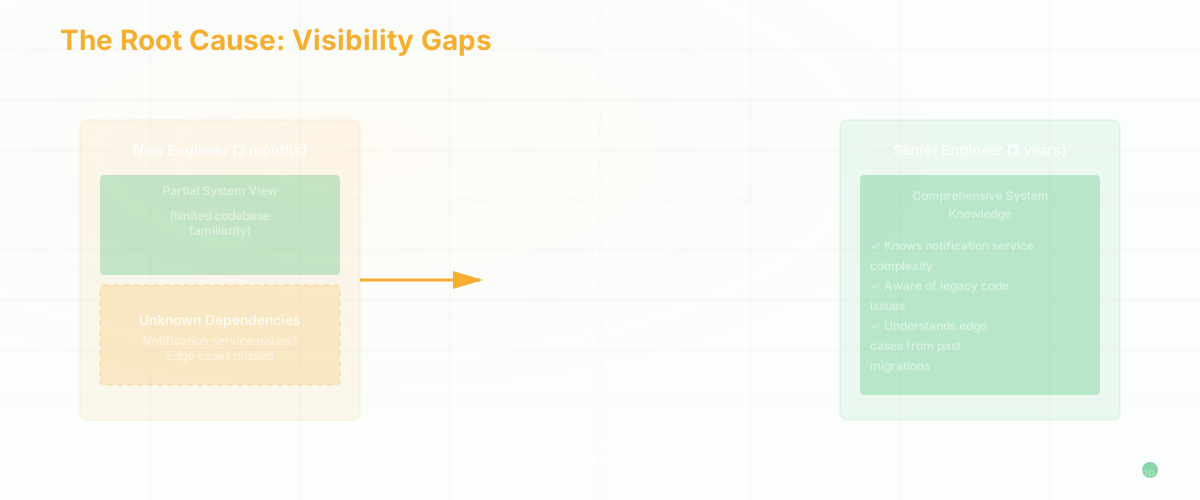
And it gets worse over time. As codebases grow and teams change, the percentage of the system that any single engineer fully understands shrinks. At a 20-person engineering org with 500K lines of code, nobody has a complete mental model. Everyone is estimating against a partial picture. The estimates reflect the picture, not the reality.
The Agile community has spent twenty years treating this as an estimation methodology problem. Try planning poker. Try T-shirt sizing. Try no estimates. None of these address the root cause, which is that the inputs to estimation - system knowledge, dependency awareness, complexity understanding - are incomplete.
What Story Points Actually Measure
If story points don't reliably measure complexity, what do they measure?
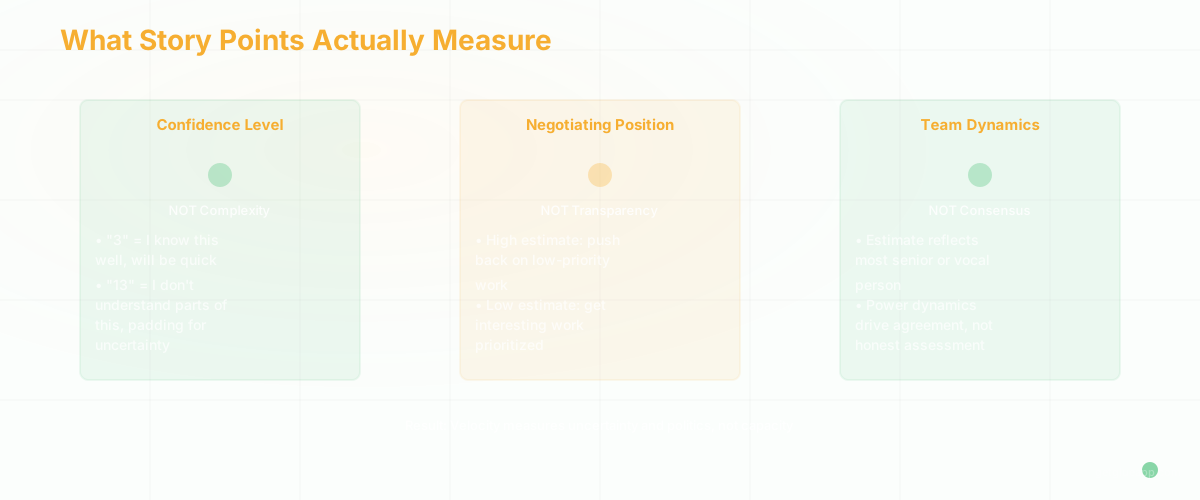
In my experience, story points measure three things, none of which are what teams think they're measuring.
First, they measure confidence level. A "three" means "I understand this well enough to do it quickly." A "thirteen" means "I don't understand parts of this and I'm padding for uncertainty." The number isn't complexity. It's a proxy for how well the estimator knows the relevant parts of the codebase.
Second, they measure negotiating position. When a PM sees "thirteen points" next to a feature, they push back or reprioritize. Engineers learn this and calibrate their estimates not to reflect reality but to achieve the outcome they want. High estimates on work they don't want to do. Low estimates on work they find interesting. This isn't malicious. It's human.
Third, they measure team dynamics. The estimate that survives planning poker is often the estimate of the most senior or most vocal person in the room. Consensus-based estimation in a room with power dynamics isn't consensus. It's conformity.
Velocity - the sum of story points completed per sprint - inherits all these distortions. A team with a velocity of 40 hasn't done 40 units of work. They've completed 40 units of estimated-work-filtered-through-confidence-negotiation-and-dynamics. Trend it over time and you get useful-ish capacity data. Use it as a target and you get Goodhart's Law: the measure becomes a target, the target corrupts the measure, and everyone pads estimates to hit the number.
Better Approaches That Actually Work
I'm not going to tell you to abandon sprint planning. Coordination is necessary. But the way most teams do it optimizes for the wrong thing. It optimizes for commitment accuracy (did we do what we said we'd do?) when it should optimize for decision quality (did we work on the right things with a realistic understanding of complexity?).
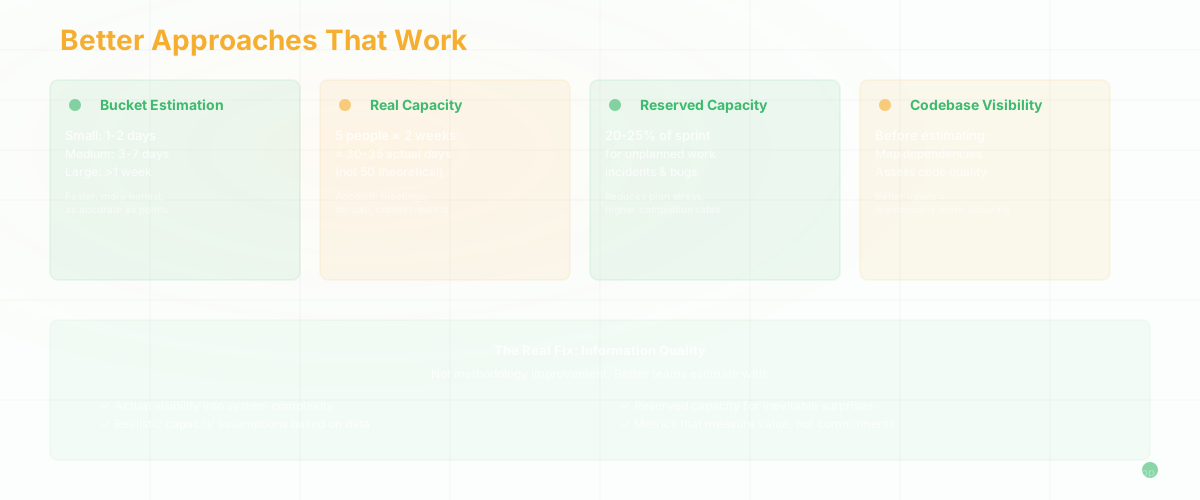
Estimate in buckets, not points. Small (fits in a day or two), medium (a few days to a week), large (more than a week - probably needs to be broken down). Bucket estimation is faster, more honest, and statistically about as accurate as story points In my experience. You lose the false precision. You gain the honesty.
Plan for real capacity, not theoretical capacity. A five-person team with a two-week sprint has 50 person-days of theoretical capacity. In reality, they have 30-35 after meetings, code review, on-call duties, Slack interruptions, and context switching. A 2019 study by RescueTime found that developers average 2 hours and 11 minutes of uninterrupted focus time per day. Plan for the reality, not the theory.
Reserve capacity for the unknown. Allocate 20-25% of every sprint for unplanned work: production incidents, urgent customer issues, the bug that surfaces on Tuesday that nobody anticipated. When the unplanned work arrives, it doesn't break your sprint. It was expected. Teams that reserve capacity report significantly less planning stress and higher completion rates.
Make the codebase visible before you estimate. This is where the leverage actually is. If the estimation gap is really a knowledge gap, the fix isn't a better estimation process. It's better knowledge.
Before estimating a feature, the team should be able to answer: what systems does this touch? What are the dependencies? What's the state of the code in the affected areas - is it clean and well-tested, or fragile and undocumented? Who has worked on these systems recently?
Answering these questions used to require the most senior engineer's time and memory. With codebase intelligence tools, you can surface this information automatically. When the team can see the actual complexity before they estimate, the estimates get dramatically more accurate - not because the methodology improved, but because the inputs did.
The Real Fix
Sprint planning will always involve uncertainty. Software is complex, and no estimation process can fully account for emergent complexity. But the gap between current practice and realistic practice is enormous.
Most teams estimate in a room with incomplete information, driven by social dynamics, measured by a metric that incentivizes gaming, and compared against a plan that was fiction from the moment it was created.
Better teams estimate with visibility into the system, realistic capacity assumptions, reserved buffers for reality, and metrics that measure value delivered rather than commitments kept.
The difference isn't methodology. It's information. Give teams accurate information about their system and honest assumptions about their capacity, and the estimation process almost fixes itself. Keep the information incomplete and the assumptions optimistic, and no methodology in the world will save you.
Stop refining the theater. Start improving the visibility.
Frequently Asked Questions
Q: What are the best sprint planning tools for agile engineering teams?
A: The best sprint planning tools for agile engineering teams include Jira (most widely adopted, strong workflow customization), Linear (fast UI with built-in cycles and triage), Shortcut (balanced between simplicity and power), and Glue (adds codebase intelligence to sprint planning — surfaces which areas of the system a ticket will touch and what risks exist before estimation). The critical gap in most tools is that they track work but don't provide visibility into the codebase, which is why estimation accuracy suffers. The most effective setup combines a project tracker with cycle time analytics and pre-sprint codebase analysis.
Q: Why does sprint planning fail?
Sprint planning fails primarily because the people estimating work cannot fully see the system they're estimating against. Estimation accuracy depends on codebase familiarity, but as systems grow and teams change, no single person has a complete picture. The result is estimates based on partial information, which are systematically wrong.
Q: Are story points useful?
As relative sizing tools for capacity planning, yes - trending velocity over time gives useful data about throughput. As precision estimates for individual features, no - they measure confidence and familiarity more than complexity. The most honest approach is bucket estimation (small/medium/large) combined with historical capacity data.
Q: What's better than story points?
Bucket estimation (small/medium/large/needs-breakdown) combined with realistic capacity planning (accounting for meetings, on-call, and unplanned work) and pre-estimation visibility into the affected codebase areas. The improvement comes from better inputs to estimation, not better estimation methodology.
Related Reading
- Sprint Velocity: The Misunderstood Metric
- Cycle Time: Definition, Formula, and Why It Matters
- DORA Metrics: The Complete Guide for Engineering Leaders
- Programmer Productivity: Why Measuring Output Is the Wrong Question
- Software Productivity: What It Really Means and How to Measure It
- Automated Sprint Planning: How AI Agents Build Better Sprints
- Software Estimation Accuracy
- Why Software Estimation Is Structurally Hard
- What Is Agile Estimation?
- What Is Effort Estimation?
- What Is Sprint Estimation?
- What Is Project Duration Estimation?
- What Is Estimation Best Practices?
- The Complete Guide to Software Estimation
- Brooks' Law Visualized
- Scope Creep Prevention
- What Is Scope Creep?
- The Roadmap as a Command Center
- Glue for Engineering Planning
- Sprint Intelligence Loop
- Automated Sprint Planning Guide
- Glue vs Linear