
Software Estimation Accuracy
To improve software project estimation accuracy, replace gut-feel estimates with data-driven approaches: use historical cycle-time distributions from your version control system, break work into sub-day tasks (items under 4 hours have 3x higher accuracy), and apply reference-class forecasting by comparing new work to similar past deliveries. The most effective estimation tools — including Glue, LinearB, Jellyfish, and Pluralsight Flow — pull actual engineering data (commit history, PR cycle times, deployment frequency) to calibrate future estimates against past performance rather than relying on story points or developer intuition alone.
I've shipped hundreds of estimates across three companies. My accuracy improved dramatically when I stopped relying on gut feel and started using historical data from our actual codebase.
By Priya Shankar
Software estimates are systematically wrong, and I'm tired of pretending it's because engineers are bad at math.
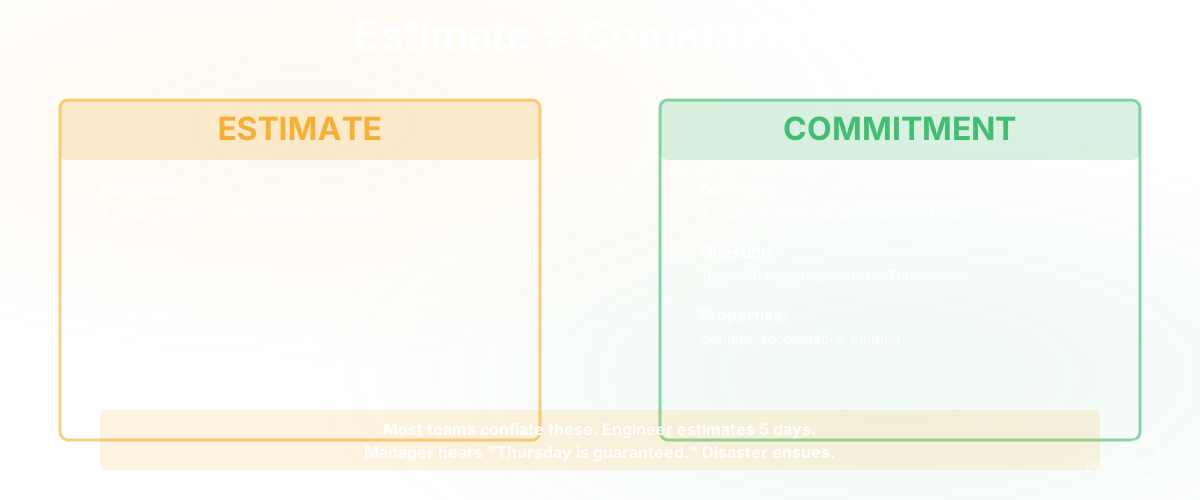
Here's what actually happens: I ask an engineer "how long will this take?" They're thinking about the implementation ( - ) the code they'll write, the tests they'll run, the integration they'll handle. They estimate 5 days. I assume that means 5 business days. Thirty-two hours. Thursday afternoon.
Then the estimate gets locked in. It becomes a deadline. It becomes a commitment. Other features get scheduled based on that date. When the estimate is wrong ( - ) and it will be ( - ) everything downstream shifts. The sprint slips. The roadmap slips. I look like I can't estimate. The engineer looks like they can't deliver.
Nobody's actually bad at math. Estimation is a prediction problem. It has high variance. We treat it like an arithmetic problem with a right answer.
Let me be specific about how estimation fails, because I've watched this play out at three different companies.
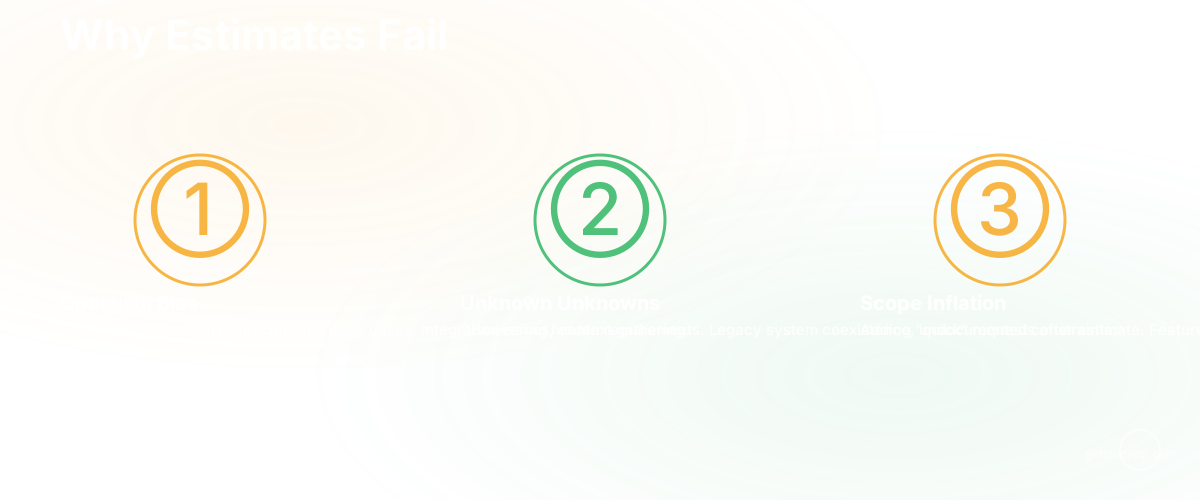
First: optimism bias. This is Kahneman's planning fallacy applied to engineering. Engineers estimate the work they can see ( - ) the happy path implementation. They don't estimate the work they can't see ( - ) the edge cases, the integration issues, the code they'll have to read to understand what's already there. They're not lying. They genuinely don't know about it yet.
I did a retrospective with an engineering team once. The estimate was 5 days. The actual work was 12 days. We asked where the extra time went. 40% of it was "understanding how the existing payment system works before we could integrate with it." They didn't know that upfront. The estimate was accurate for the work they could visualize. It was wildly inaccurate for the full scope.
Second: missing unknown unknowns. You don't know what you don't know. The spec is clear. The engineer starts building. They discover that the legacy system and the new system have to coexist for six months. That wasn't in the spec. Scope just grew.
Third: scope inflation after estimates are given. Once an estimate is public, it becomes a constraint. I budget 5 days for the feature. Then I realize the feature isn't complete without a small UI fix. So I ask the engineer to do the UI fix "quickly." The engineer knows it'll take two days, but they've already committed to five days for the main feature. So they either run over, or they do sloppy work.
What actually works? I've seen three practices that actually improve estimation:
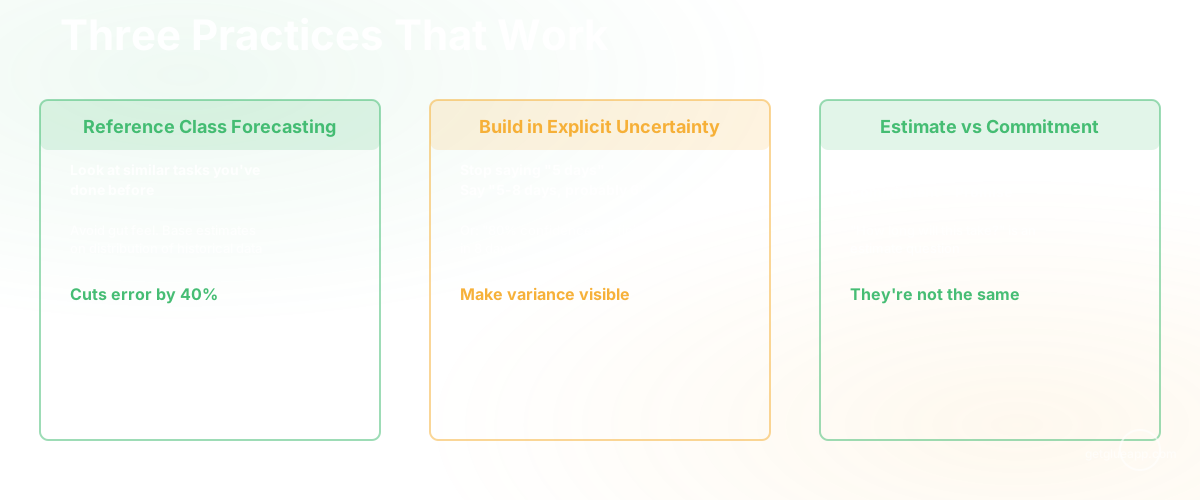
Reference class forecasting. Don't estimate a task in isolation. Look at similar tasks you've done before. How long did they take? Average them. Base your estimate on that distribution, not on gut feel. This sounds boring and obvious. It's not obvious ( - ) most teams never do it. They estimate each task like it's the first time they've ever done anything remotely similar. Reference class forecasting cuts estimation error by about 40%.
Build in explicit uncertainty. Stop saying "5 days." Start saying "5-8 days, probably 6." Or better: "80% confidence we finish in 8 days." Make the variance visible. I can plan around "5-8 days." I can't plan around "5 days" that secretly means 8-12.
Distinguish between estimates and commitments. An estimate is a prediction. A commitment is a promise. Those are not the same thing. If I ask you "how long will this take?" that's an estimate question. If I ask you "can you have this done by Thursday?" that's a commitment question. Most teams conflate them. You estimate 5 days. I hear "Thursday is possible." You mean "there's a reasonable probability." I hear "Thursday is guaranteed." Disaster.
Here's what shifted my thinking about estimation: the best estimates I've ever seen came from engineers who intimately understood the codebase they were about to modify. Not necessarily the smartest engineers. The ones who'd worked on that system for years. They knew the hidden complexity. They knew what'd been tried before. They knew where the weird edge cases were.
This changes how I approach estimation. Instead of asking "how long?" and hoping for accuracy, I now think about whether the engineer has the context to estimate well. If they don't, the estimate is a guess. If they do, it's probably pretty good.
This is why codebase understanding matters, by the way. An engineer who can navigate the codebase, see the dependencies, understand what's already built, will estimate better. They're not predicting based on specification. They're predicting based on the actual system they're working in.
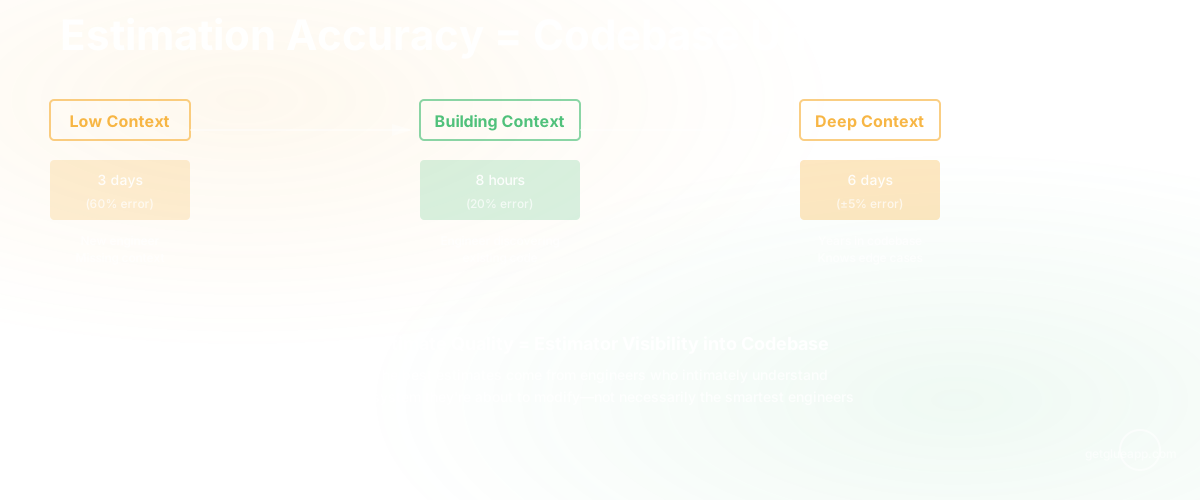
I had an engineer once who'd been in our codebase for a week. She estimated a feature at 3 days. Seemed optimistic. Then she actually looked at the code, saw that we'd already built 70% of the feature in a different context, and revised the estimate to 8 hours. She was still missing context, but she had more. The estimate improved.
This is what most teams miss about estimation. The estimate quality depends on the estimator's visibility into the actual codebase. Faster estimates aren't better. Accurate estimates are better. And accuracy comes from understanding.
I also learned to be honest about the limits of estimation. Some work is genuinely high-variance. Research spikes. Work that touches legacy systems. Work that requires discovering what's possible before you can estimate it. For that work, I don't ask for a point estimate. I ask for a time-boxed exploration. "Spend two days investigating. Then tell me if this is a one-week project or a one-month project."
Here's what I wish someone had told me earlier: estimation isn't a PM skill. It's a shared visibility problem. Estimates are terrible when PMs and engineers don't have the same mental model of what the work entails. Estimates get better when we both understand the codebase, the scope, and the dependencies before we start predicting.
Frequently Asked Questions
Q: How do you improve software project estimation accuracy?
A: The most effective way to improve estimation accuracy is to replace gut-feel estimates with historical data. Track actual cycle time by work type (bug fix, new feature, refactor) and use those distributions to calibrate future estimates. Three specific techniques work: (1) break work into sub-day tasks — items under 4 hours have 3x higher accuracy, (2) use reference-class forecasting by comparing new work to similar past deliveries, and (3) do pre-estimation codebase analysis so the person estimating can actually see the code they're estimating against. Tools like Glue, LinearB, and Pluralsight Flow pull actual engineering data to make this practical. The accuracy improvement comes from better inputs, not better methodology.
Q: Should we use story points instead of time estimates? Story points don't solve the underlying problem ( - ) they just obscure it. You can estimate relative complexity (this is bigger than that), but you can't escape the fact that you need to convert points to time eventually. And the conversion factor is just as likely to be wrong. Story points feel more precise because they're not in time, but that's an illusion.
Q: What if we just get better at breaking work into smaller pieces? Breaking work into smaller pieces helps. Smaller pieces are easier to estimate. But estimation error scales with scope size, not piece count. If you break a 5-day task into five 1-day tasks and estimate them all at 1 day, you haven't improved accuracy. You've just distributed the error across five estimates. Better to estimate the whole thing with a range.
Q: Isn't estimation just about team velocity? Velocity tells you how much work your team accomplished, not how accurate your estimates were. A team could be wrong consistently (estimate 50 points, deliver 35) but have stable velocity. You need both ( - ) accurate estimates and velocity tracking. One doesn't substitute for the other.
Related Reading
- Sprint Velocity: The Misunderstood Metric
- Cycle Time: Definition, Formula, and Why It Matters
- DORA Metrics: The Complete Guide for Engineering Leaders
- Programmer Productivity: Why Measuring Output Is the Wrong Question
- Software Productivity: What It Really Means and How to Measure It
- Automated Sprint Planning: How AI Agents Build Better Sprints