
Shift Left Testing: Why It Actually Matters (And When It Doesn''t)
Shift-left testing is genuinely valuable. But it has limits. And most teams don''t understand what those limits are.
The core idea is sound: catch bugs earlier in development, before they reach testing or production. A bug caught at unit test stage costs minutes to fix. The same bug caught in production costs hours of incident response, customer communication, and damage to trust.
The IBM Systems Sciences Institute did a study in 1994 that showed this precisely: a defect costs 1x to fix in design, 3x if discovered during unit testing, 10x if found in system testing, and up to 100x if discovered in production. That study is old, but the principle holds.
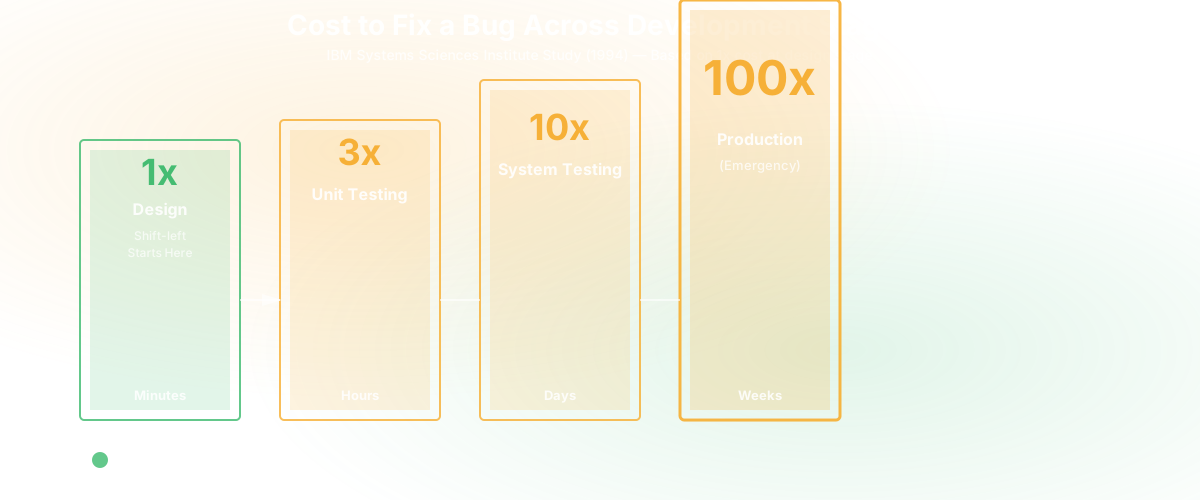
So shift-left is real. But it''s not free. And it doesn''t solve every problem.
What Shift-Left Actually Gives You
First, let me be clear about what shift-left testing does deliver:
Cheaper bug fixes. A unit test that catches a logic error is cheaper to fix than a customer-reported production bug. This is unambiguously true.
Faster feedback loops. Developers get immediate signal about whether their change works. They don''t wait three days for testing. The feedback loop closes in minutes. This changes how developers think. They get faster at identifying what they did wrong.
Better code design. Writing testable code forces you to design with testing in mind. Testable code is usually less tightly coupled, more modular, easier to change. This is a real win beyond just catching bugs.
Confidence for refactoring. With good test coverage, you can refactor without fear. The tests tell you when you broke something. This enables technical debt reduction.
These are substantial wins. In a mature team with good testing infrastructure, shift-left is powerful.
Where Shift-Left Fails
But it has limits.
First: It doesn''t catch integration problems. Unit tests test functions in isolation. They don''t test whether function A''s output is compatible with function B''s input. They don''t test whether services can communicate. They don''t test data races between concurrent operations.
The most expensive bugs I''ve seen were integration bugs. Service A commits data to the cache. Service B doesn''t know the cache exists. Service C invalidates the cache at the wrong time. None of these are caught by unit tests. All of them are caught by integration tests or production.
Shift-left unit tests gave you fast feedback. But the critical bugs still needed integration testing.

Second: It creates a false sense of security. A test suite with 95% code coverage can have huge gaps in actual testing. If the tests don''t test the right scenarios, they''re not catching the important bugs.
I''ve seen unit tests that achieve 95% coverage but miss: race conditions, off-by-one errors in boundary cases, error handling for network timeouts, permission checks in the authorization layer.
Why? Because unit tests are usually written by the same engineer who wrote the code. They test the happy path and the paths they think about. They miss the paths they didn''t think about.
The high coverage number becomes a false alarm: "We''re 95% covered, we''re safe." You''re not. You''re safe for the scenarios you tested.
Third: It doesn''t work well with rapid requirement changes. If your requirements are stable ( - ) features are clear, scope is understood ( - ) shift-left is great. You write tests for the spec. The tests stay relevant.
But if requirements change every week, tests become a liability. You write a test for "users can update their profile." Three weeks later, "users can update their profile" means something different. Your test is now enforcing the old spec. You spend time updating tests instead of implementing features.
For highly iterative work ( - ) startups finding product-market fit, teams with changing requirements ( - ) shift-left can create more overhead than value.
Fourth: It requires infrastructure investment. Good shift-left testing requires: test infrastructure (mock frameworks, test databases, test fixtures), test data management, test maintenance, and developer training.
Small teams with immature testing infrastructure don''t have this. They spend 70% of test-writing time on setup and maintenance, 30% on actual testing. For them, shift-left creates more overhead than value.
A 3-person team trying to ship fast shouldn''t invest heavily in unit test infrastructure. A 50-person company with three backend teams should.
When Shift-Left Doesn''t Help
There are specific scenarios where shift-left testing isn''t worth the investment:
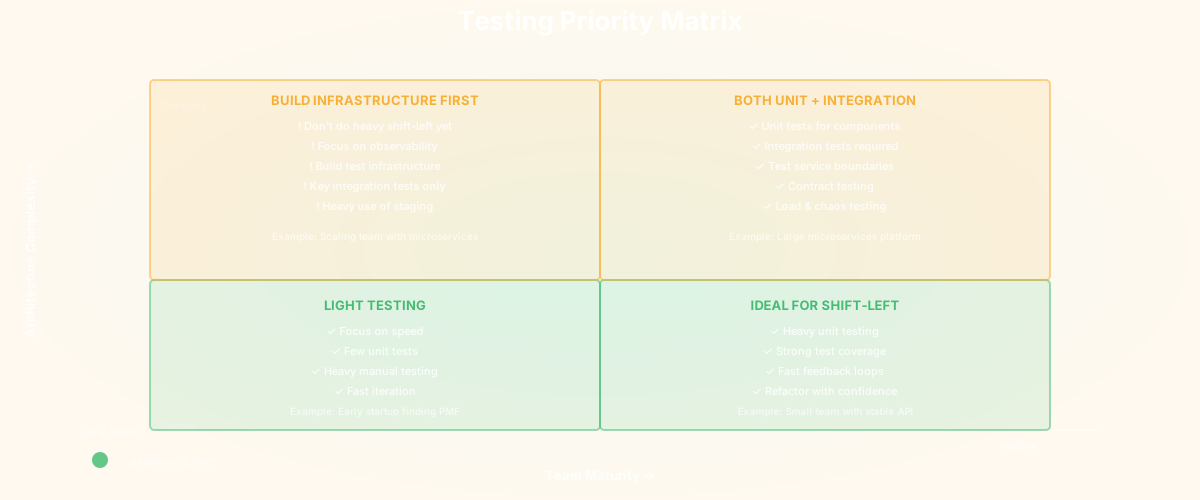
Scenario 1: Your main risk isn''t unit behavior, it''s integration. If your architecture is inherently complex ( - ) many services, complex orchestration, tight integration ( - ) unit tests won''t catch your worst bugs. They''ll be integration bugs. Invest in integration testing first.
Scenario 2: Your team is small and early-stage. If you''re a 5-person startup trying to achieve product-market fit, don''t invest in heavy unit testing infrastructure. Write some unit tests for critical paths. Rely more on manual testing and fast iteration.
Scenario 3: Your requirements change faster than your tests. If your product specs are stable, test investment pays off. If they change every sprint, tests become a maintenance burden. Know the difference.
Scenario 4: You don''t have the infrastructure to do it well. If you don''t have a good test framework, mock library, and test data strategy, doing shift-left testing creates more pain than benefit. First build the infrastructure. Then do shift-left.
Actually Doing Shift-Left Right
If you decide shift-left is right for your context, here''s what actually works:
Write tests for the critical paths first. Authentication, payment, data persistence. These touch the most risk. Get those covered. Don''t aim for 100% coverage everywhere.
Test behavior, not implementation. Unit tests that test the exact implementation are brittle. They break when you refactor. Test the behavior: given this input, expect this output. Don''t test the internal details.
Keep test maintenance cost low. Use fixtures. Use test data factories. Don''t hardcode test data. Don''t have tests that are harder to maintain than the code they test.
Pair unit tests with integration tests. Unit tests catch behavior bugs. Integration tests catch integration bugs. You need both.
Measure whether tests are catching bugs. If you ship code with tests and incidents still hit production, your tests aren''t catching what matters. Change your testing strategy.
The Honest Truth
Shift-left testing is valuable when:
- Your architecture is relatively simple
- Your requirements are stable
- Your team has mature testing infrastructure
- Your main risk is unit behavior, not integration
- You have senior people to design good tests
Shift-left testing is overhead when:
- Your main risk is integration, not unit behavior
- Your requirements change frequently
- You don''t have testing infrastructure
- You''re a small team optimizing for speed over coverage
- Your engineers are junior and need time to learn testing practices

The best teams I''ve worked with don''t have an absolutist view on shift-left. They understand their context. They invest in testing where it matters. They skip testing where it doesn''t. They measure whether tests are actually catching bugs.
They don''t cargo-cult "100% coverage." They think about what risk matters in their system and test accordingly.
Frequently Asked Questions
Q: What''s the minimum unit test coverage we should have?
Not a percentage. Focus on coverage of critical paths. If your payment processing, authentication, and data persistence are covered at 80%+, you''re in decent shape. If they''re at 40%, you have risk.
Q: Should we require tests for every change?
For critical systems, yes. For low-risk systems, maybe not. For a feature flag system or admin dashboard, you can get by with less testing than payment processing.
Q: Is 100% code coverage a good goal?
No. It''s a vanity metric. Aim for 90%+ on critical paths, 60%+ elsewhere. Know what''s not covered and why. That matters more than the number.
Related Reading
- What Is Technical Debt Tracking?
- What Is Technical Debt Prioritization?
- Technical Debt Patterns: The 7 Types Costing You the Most
- Technical Debt Statistics 2026: The Real Cost of Maintenance
- The CTO''s Guide to Product Visibility