
The question is wrong.
Not because the answer is "no" - that's actually the boring part. The real question is what happens to product management when AI gets really good at the parts of PM work that were never actually PM work.
I spent years as a PM before I started building products for PMs. I watched the job evolve. And I've watched AI get better at the mechanical parts - writing PRDs, running research, summarizing meetings, generating strategic frameworks. The question most people ask is "will AI replace me?" The question you should be asking is "what's left when the mechanical work goes away?"
The answer is surprisingly small. And surprisingly hard.
What AI Actually Replaces
Let me be specific. These parts of PM work are going away:
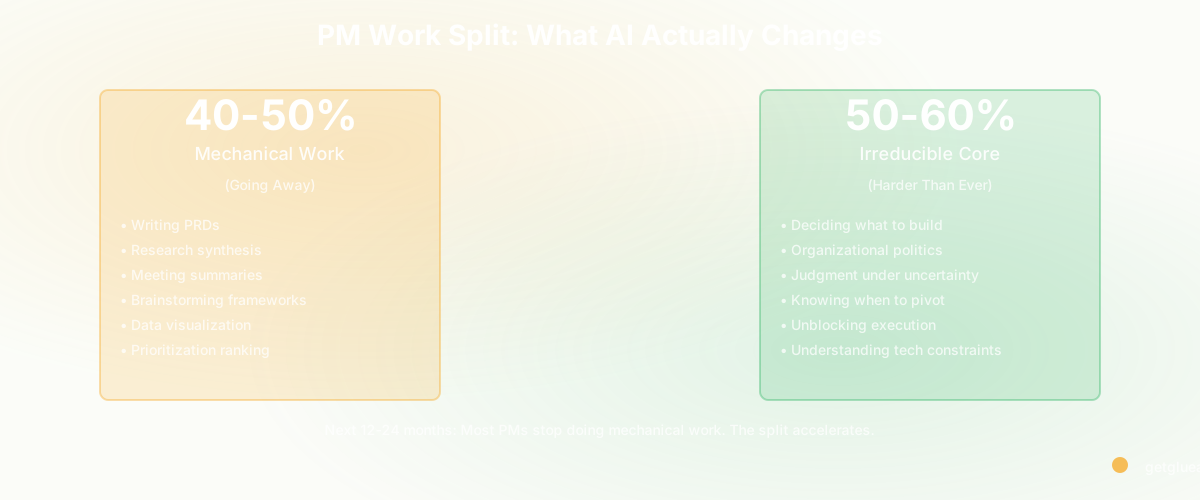
- Writing PRDs. AI can generate a decent first draft in minutes. Humans will do the judgment, but the output itself is machine-generated.
- Research synthesis. You can feed AI dozens of user research interviews, competitive analyses, market data, and it'll synthesize patterns. A human PM will still decide what the patterns mean, but humans aren't generating the raw synthesis anymore.
- Meeting summaries. Transcribe and ask AI for notes. Done. That was 45 minutes of manual work.
- Brainstorming frameworks. "Give me five ways to think about the loyalty problem" is now an AI task. Humans will evaluate which frames matter, but generating them isn't human work anymore.
- Data presentation. AI can pull data, clean it, visualize it, and format it for stakeholders. Humans decide what's actually important, but the work of presentation is automated.
- Some forms of prioritization. If you give AI clear input criteria - revenue impact, user volume, strategic importance - it can rank things. A human needs to set those criteria and review the output, but the mechanical ranking is done.
This is a lot of PM work. It's probably 40 - 50% of the job. And it's going away in the next 12 - 24 months. Most PMs will stop doing it. Some will still do it because they don't realize they can offload it. Some will do it anyway because they like it.
What Actually Matters
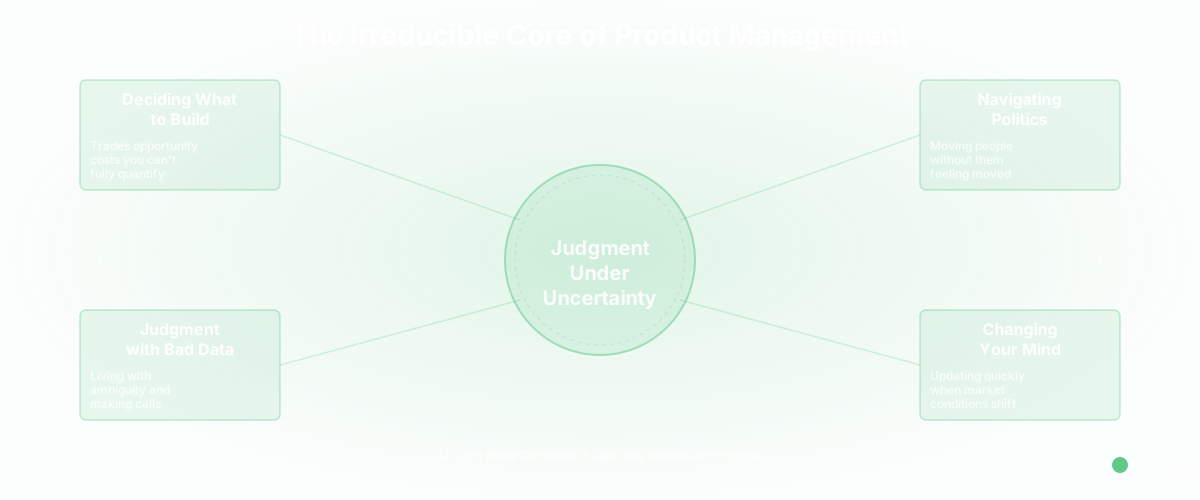
The irreducible core of product management - the part that doesn't get easier with AI - is making decisions with incomplete information under uncertainty, then navigating the organization to execute them.
That's not a hard skill that looks like a soft skill. It's the hard skill. Everything else is support work.
This includes:
Deciding what to build. Not "what does the market want" - AI can help with that. But "what does our market want more than they want the thing we'd have to give up to build this?" That's a judgment call. You're trading off opportunity costs that you can't fully quantify. You're making a bet about where the market is going. You're saying "I think this feature will change the trajectory of the company" when you might be wrong. AI can give you information. It can't make the bet for you.
Navigating organizational politics. This is the part PMs talk about least, probably because it sounds uncomfortable. But most product decisions aren't made on merit. They're made because someone needs to support them internally. You need to know who actually has power, what they care about, who's threatened by this decision, who benefits, how to move people without making them feel moved. This is profoundly human work. AI isn't going to replace it.
Making judgment calls with bad data. You're almost always operating with data that's incomplete, contradictory, or wrong. The person who can live with that ambiguity and make a call anyway wins. The person who waits for clarity loses because clarity rarely comes. That's not a skill you train, and it's definitely not something AI does well.
Knowing when to change your mind. You make a decision, the market moves, the team learns something, and you realize you were wrong. Good PMs change their minds quickly. Bad PMs defend bad decisions because they need to be consistent. AI doesn't have ego in the conversation, so it's slightly better at updating. But the actual work of "I was wrong, here's what we're doing now" is still human.
Understanding why execution is hard. After the decision is made, the real work starts. You're not actually executing the feature - engineers are. But you're unblocking them, you're explaining the vision, you're navigating conflicts between what they think is right and what the feature needs. You're watching the codebase and understanding when a technical constraint becomes a product problem. This requires deep understanding of both the product and the system. AI can help with visibility, but the navigation is human.
The Harder Truth
Here's what's actually going to happen: The PM job is splitting.
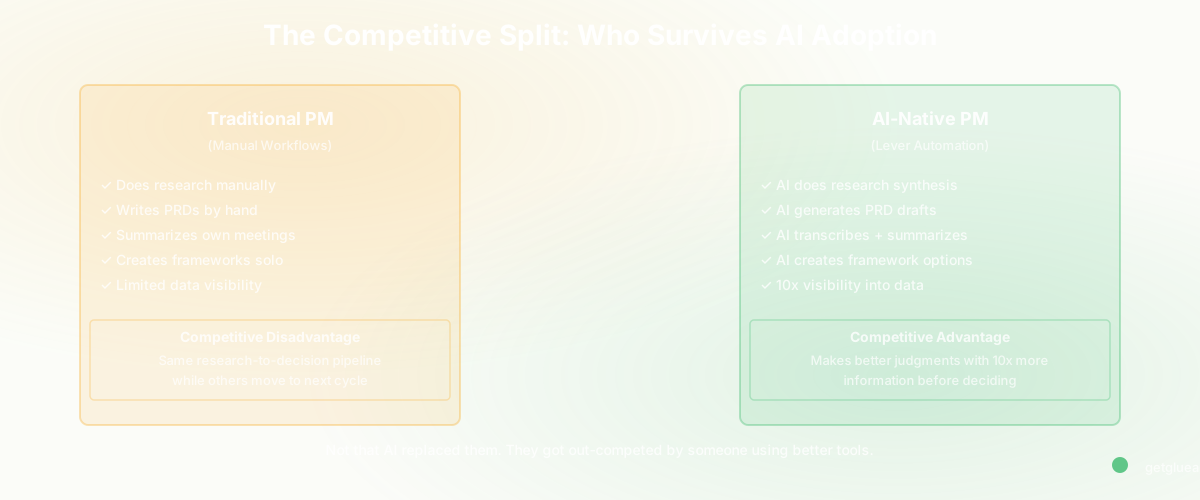
The PM who uses AI to do 10x the research, synthesis, and framework work will replace the PM who does it manually. Not because AI is better at judgment - it isn't. But because the PM with AI will have visibility into 10x more information before making the judgment. And that PM's judgments will be better on average.
The PM who doesn't adopt AI for the mechanical work will look slower and less informed. They'll be doing the same research-to-decision pipeline while the AI-native PM has moved on to the next cycle. It's not that AI replaced them. It's that they got out-competed by someone using better tools.
This happened with spreadsheets. This happened with data dashboards. This happened with email. The tools didn't eliminate jobs - they raised the bar for what counts as competent.
What Glue Does Here
I built Glue partly because I realized that the judgment part of PM work - deciding what to build - depends on understanding the system. But most PMs don't have visibility into what's actually in the codebase, how it's organized, what's fragile, what's stable, what's changing.
AI is great at synthesis. But you have to give it something to synthesize. If a PM doesn't know that the auth module has been rebuilt twice in the last year, or that the checkout flow touches fifteen different services, they can't even ask the right questions. Glue gives PMs that visibility so they can ask better questions, and AI can help synthesize better answers.
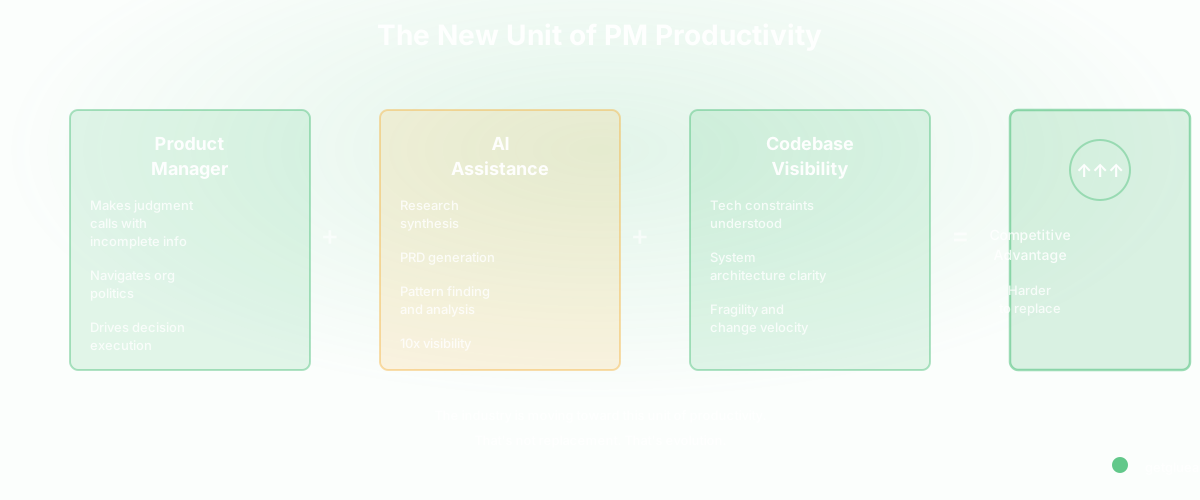
This is why "can AI replace PMs" is the wrong question. The right question is "what does a PM do when they have both codebase visibility AND AI assistance?" The answer is: they're much harder to replace because they're operating with information that was previously hidden.
What This Means for You
If you're a PM worried about AI: Stop. The worry is misdirected. What you should worry about is whether you're adapting. The PM who learns to use AI for research, synthesis, and pattern-finding will be more valuable. The PM who fights it will be less useful.
If you're an engineering leader wondering whether PMs will become redundant: No. But PMs are about to get a lot better or a lot worse, and there won't be a middle. The ones with visibility and AI assistance will make better decisions. The ones without will make decisions in a fog.
The industry is moving toward PM + AI + codebase visibility as the unit of productivity. That's not a replacement. That's the evolution of the role. The PM who can see the system, leverage AI for the mechanical work, and focus on judgment will be the competitive advantage. The PM who can't will be the blocker.
Frequently Asked Questions
Q: Should I learn to code to stay relevant? A: No. That's the wrong adaptation. What you need is visibility into what's in the codebase - what changed, where, how often, what's fragile - without needing to read code. That's way more valuable than coding skills. Focus on understanding the system architecture and how your features connect to it. Glue does that for you without you learning Python.
Q: What if my company doesn't want to invest in these tools? A: Then you're operating at a disadvantage. Not because the tools are magical - they're not. But because your competitors who have visibility and AI assistance will make better decisions faster. If you can't get your company to invest, start by asking your lead engineer to spend an hour walking you through the codebase structure. You don't need expensive tools to start - you need curiosity and visibility.
Q: Is this a productivity play or a replacement play? A: It's a competitiveness play. AI doesn't make PMs obsolete. It makes incompetent PMs a lot more obvious. If you were getting by on charisma and spreadsheets, AI-native competitors will out-think you. If you were getting by on domain knowledge that was actually just being more curious than everyone else, you'll stay ahead - but barely. The ceiling moved up for what counts as good PM work.
Related Reading
- What Is Story Point Estimation?
- What Is Agile Estimation?
- Story Points Are Useless
- Velocity Doesn't Tell You How Far You Need to Go
- Glue for Engineering Planning