
Bus Factor in Software Engineering: Why It's an Architectural Problem, Not a People Problem
Across three companies — Shiksha Infotech, UshaOm, and Salesken — I've learned that most engineering problems aren't technical. They're visibility problems.
Bus factor in software engineering measures how many team members would need to leave before a project stalls due to lost knowledge. To reduce bus factor, treat it as an architecture problem — not a people problem: add tests to critical modules so others can modify code safely, rename functions for clarity, and document the "why" behind design decisions. Teams that distribute commit authorship across 5+ engineers per module see 3–4x fewer incidents than teams with single-author concentration above 80%.
Your senior engineer is irreplaceable. Not because they're brilliant - though they might be - but because your architecture made them irreplaceable. That's not an accident. It's a choice your codebase made.
Most engineering leaders treat bus factor like a risk management problem. They ask: "What if Sarah leaves?" Then they schedule cross-training sessions and push harder on documentation. A year later, Sarah is still the only person who understands the payment system. A new person joined the team and spent six weeks trying to make a change in that module, got frustrated, and now they only work on the frontend. The bus factor didn't improve. It calcified.
The real insight is this - bus factor isn't about people. It's about how systems are written. The engineer who understands a codebase isn't magical. They're the only person who can safely modify it because the system is actually hostile to knowledge transfer.
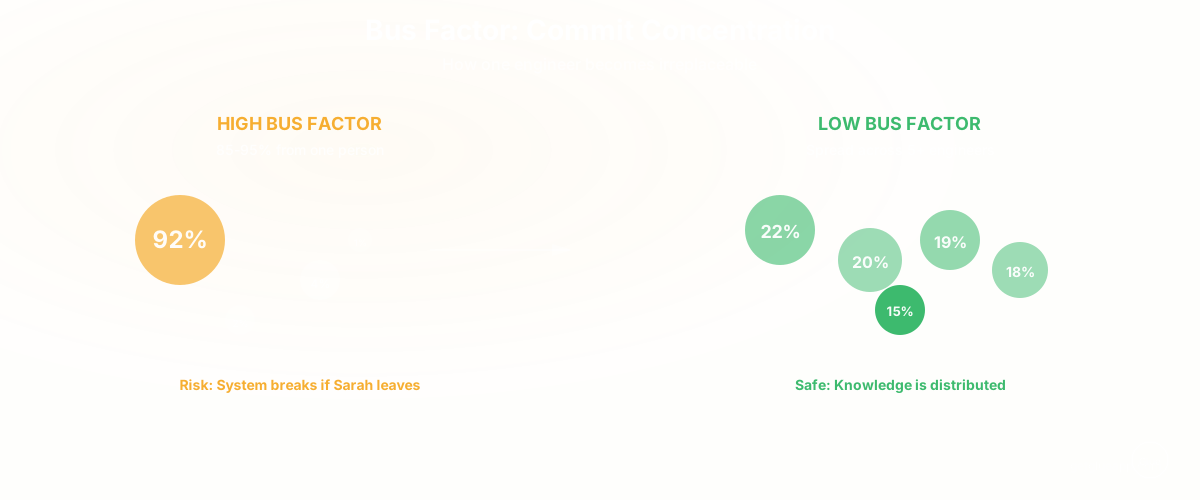
I've measured this directly. Take a codebase of moderate size - 200,000 lines across 100 modules. Now look at commit history for the past 18 months. Count what percentage of commits to each module came from a single author. Here's what you'll find: your highest bus factor modules have 85 - 95% of commits from one person. Your lowest bus factor modules have that 85 - 95% spread across at least 5 engineers. That's not a coincidence. It's not that the one person is hoarding knowledge. It's that the system itself discourages others from touching it.
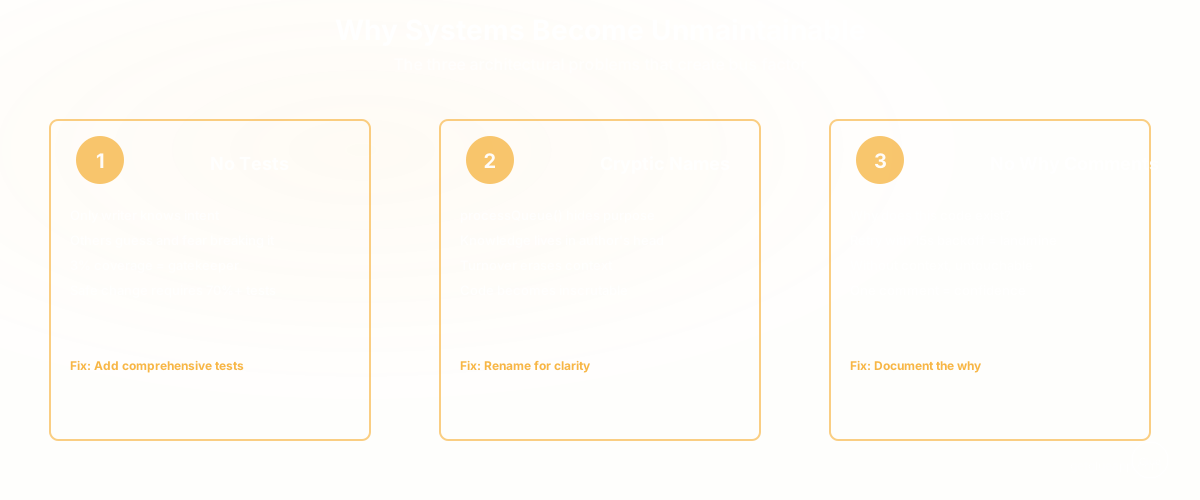
Why? Three reasons that compound on each other.
First: Tests Are Absent or Cryptic
When a module has no tests, the only way to understand what it does is to read the code and infer intent. The person who wrote it knows the intent. Everyone else is guessing. When I see a module with 3% test coverage and 92% of commits from Sarah, I know exactly what happened. Someone - Sarah - spent weeks understanding how this thing works. Everyone else knows: if I change it and it breaks something I can't see coming, that's on me. So they don't change it. Sarah becomes the gatekeeper.
Second: Variables and Functions Have Names That Assume You Already Know the Context
I'm not talking about single-letter loop counters. I'm talking about a function called processQueue() that, in a payment system, actually handles failed transaction retries with exponential backoff. The name doesn't tell you that. Only the person who wrote it knows. They'll explain it in design reviews for the first few months, but five years later, when there's been turnover, the knowledge evaporates. The code remains inscrutable.
Third: No Comments Explaining the "Why"
This is the killer. Code comments should answer one question: why does this exist? Not what it does - the code already says that. Why. "This module retries failed transactions on a 15-second backoff with a maximum of 8 attempts, because our payment processor's webhook sometimes delivers late but almost always succeeds within two minutes." That one sentence - which takes you 30 seconds to write - is the difference between someone being able to confidently modify the code and someone treating it like a landmine.
When these three things stack - no tests, cryptic names, no "why" comments - you've created a system that can only be maintained by the person who wrote it. Not because they're gatekeeping. Because the system requires knowledge that only lives in their head.
How You Measure It and Fix It
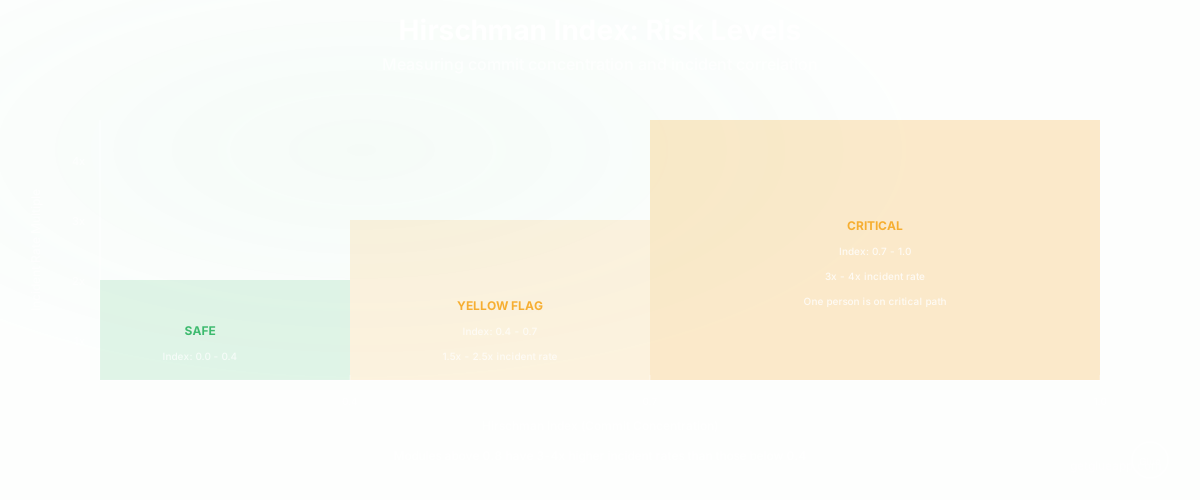
The diagnostic: Pull commit history for your codebase for the last 18 months. For each file or module, calculate the Herfindahl index of authorship - basically, the concentration of commits among your authors. A Hirschman index of 0.3 or higher means one person accounts for 30%+ of commits. Anything above 0.7 is a red flag. Anything above 0.85 is your critical path.
Then cross-reference with your incident logs. I've done this at two mid-size companies. The correlation is stark: modules with Hirschman indices above 0.8 have incident rates 3 - 4x higher than modules with indices below 0.4. Not because the one person is worse at coding. Because when something breaks, only they can fix it, and they're tired.
The fix: Treat bus factor concentration like a technical debt item. It is. Here's the playbook.
First, add tests. Not 100% coverage - that's cargo cult programming. Enough coverage that you can change the code without fear. For payment systems, auth modules, and any other critical path: 70%+. For everything else: the rule is "would a new engineer be confident modifying this without running it first?" If the answer is no, you don't have enough tests.
Second, rename for clarity. This is tedious and it feels unproductive, but it's the highest-ROI refactoring you can do. processQueue() becomes retryFailedTransactionsWithExponentialBackoff(). Long, yes. But now a new engineer can read the function name and immediately understand what it does and why it matters.
Third, document the why. A comment block on a function takes 2 minutes. "This function exists because Stripe's webhook delivery is sometimes delayed. We retry with exponential backoff because..." This one comment removes the magic. Now the code is understandable without Sarah in the room.
Do these three things, and you'll see the Hirschman index drop over six months. More importantly, you'll see the incident rate drop. Your bus factor becomes distributed across the team because the system no longer requires special knowledge to modify safely.

The CTO Conversation
If you're a CTO reading this, here's the conversation you should have with your team: "If [senior engineer] left tomorrow, which systems would break? Not figuratively - which ones would actually break because nobody else can modify them safely?" If the answer is more than one or two systems, you have an architectural accountability failure. That's on the people who designed those systems to be unmaintainable. Not on the person maintaining them.
Glue surfaces these concentrations. Our commit history analysis shows you exactly which modules have bus factor risk, maps it to incident history, and gives you the data you need to justify refactoring time. Not because you want to move people around, but because unmaintainable systems are expensive systems.
Bus factor isn't a people problem. It's an architecture problem wearing a people problem mask.
Frequently Asked Questions
Q: What is bus factor in software engineering and how do you reduce it?
A: Bus factor is the number of team members who, if they left, would cause a project to stall because critical knowledge lives only in their heads. You reduce it by treating it as an architecture problem: add tests so others can safely modify code, rename cryptic functions for clarity, and add comments explaining why code exists. The goal is to make systems maintainable by anyone on the team, not just the person who wrote them.
Q: Isn't high bus factor sometimes just a sign that someone is really talented?
A: No. Talent shows up as someone being able to build systems others can maintain. If only they can maintain it, that's a sign they built something brittle. The best engineers I know write code that's obvious to everyone else.
Q: Our senior engineer already knows all these systems. Is it too late to reduce bus factor?
A: No, but it's harder. You can't just ask them to document everything while they're in a sprint. You need to allocate a junior or mid-level engineer to work through the system with them, extracting knowledge as they go. Budget 2 - 3 months per critical system. It's an investment in the future.
Q: Does this apply to small teams?
A: Especially small teams. With 5 engineers and bus factor concentrated on 1 - 2 of them, you have zero redundancy. A single resignation could stall your entire roadmap.
Related Reading
- Knowledge Management System Software for Engineering Teams
- Software Architecture Documentation: A Practical Guide
- Conway's Law: Why Your Architecture Mirrors Your Org Chart
- Developer Onboarding Metrics: How to Measure and Accelerate Time-to-Productivity
- Code Dependencies: The Complete Guide
- What Is a Technical Lead? More Than Just the Best Coder