
An AI product manager combines traditional product management skills — roadmap prioritization, user research, stakeholder alignment — with a deep understanding of machine learning systems, data pipelines, and model behavior. Unlike conventional PMs, AI PMs must manage probabilistic outputs, training data quality, and model drift. Leading AI product management tools include Pendo (for usage analytics), Amplitude (for behavioral data), Productboard (for roadmap planning), LaunchDarkly (for feature flagging ML models), and Glue (for connecting product decisions to engineering execution data).
Building products across three companies — Shiksha Infotech, UshaOm, and Salesken — taught me that the hardest part of product development isn't building. It's knowing what to build and why.
By Vaibhav Verma
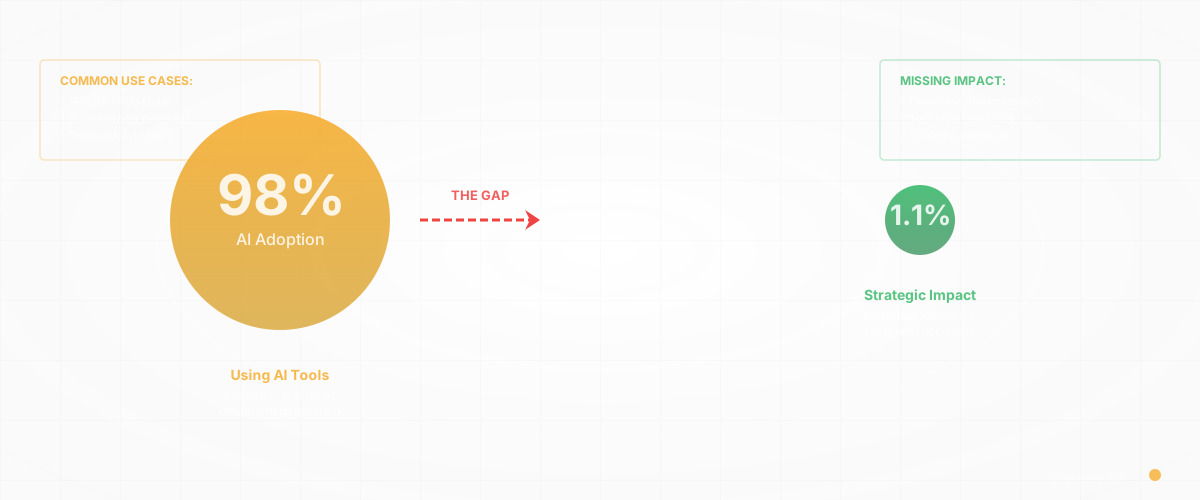
A Pendo survey from late 2025 found that 98% of product managers are using AI in some form. Sounds transformative. Then you read the details: most of them are using ChatGPT to write PRDs faster and summarize meeting notes. Only 1.1% reported using AI for roadmap ideation. Even fewer are using it to understand the product they're managing at a technical level.
So 98% of PMs have adopted AI, and almost none of them are using it for the part of their job that matters most: making better decisions about what to build.
This isn't a criticism of PMs. It's a criticism of the AI tools we've built for them. The product management AI market has optimized for the wrong problem. It's optimized for production - writing specs, summarizing feedback, generating user stories. It hasn't touched the hard part: understanding your product well enough to make decisions you're confident in.
The AI Adoption Gap in Product Management
The gap between AI adoption and AI impact in product management is wider than in almost any other function.
Engineers have Copilot and Cursor, which materially change how they write code. Designers have Figma AI and Midjourney, which materially change how they create visuals. Marketers have tools that generate copy, analyze campaigns, and optimize spend.
Product managers have tools that write documents faster. That's useful. But writing documents is not the bottleneck in product management. The bottleneck is knowing what to write in the documents.
The PM bottleneck is judgment: should we build this feature? Is it technically feasible within our current architecture? What are the hidden dependencies? How much technical debt will it create? What's the real complexity, not the estimated complexity?
These questions require understanding the product at a technical level. And the tools PMs have today don't touch that. ChatGPT can write a beautiful PRD for a feature that's architecturally impossible. Notion AI can summarize customer feedback into a neat list of feature requests without any sense of which ones are trivial to implement and which would require rearchitecting the data layer.
A 2025 HBR article put it well: AI adoption requires product management skills, but few organizations are building the bridge between AI capability and product understanding. The tools exist in silos. The understanding stays fragmented.
What AI Can Actually Do for Product Managers
Let me draw a clear line between the AI capabilities that are mature and useful, the ones that are emerging and promising, and the ones that are mostly marketing.
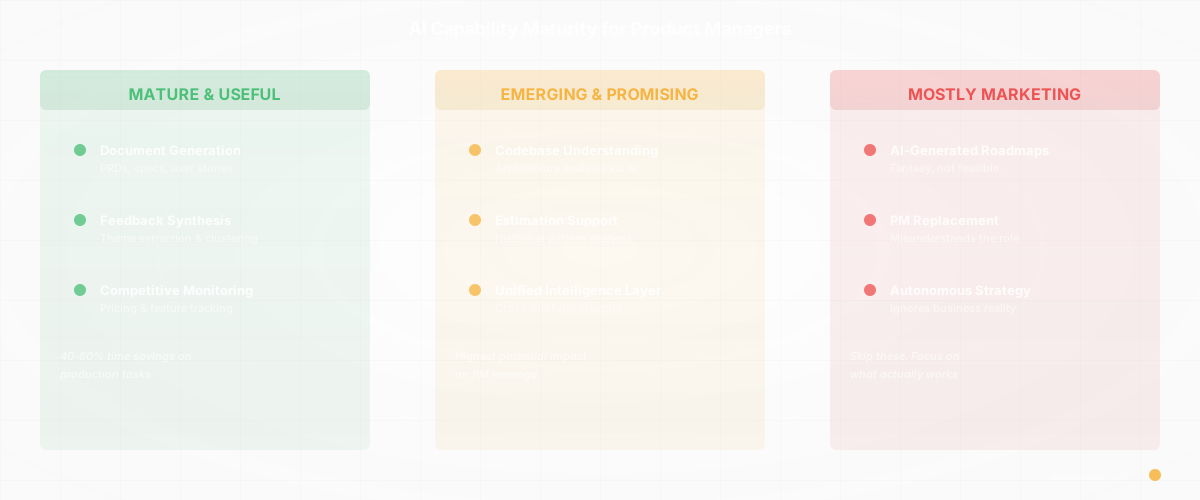
Mature and useful right now:
Document generation. ChatGPT, Claude, and Gemini can all draft PRDs, user stories, acceptance criteria, and spec documents. This saves hours per week. The output needs editing - AI tends to be verbose and generic - but it's a strong first draft. This is real time savings for a task that most PMs find tedious.
Feedback synthesis. Tools like Dovetail, Productboard, and native LLM integrations can process hundreds of customer interviews, support tickets, and survey responses and extract themes. This used to take a PM a full week. Now it takes an afternoon of review. The AI does the pattern-matching. The PM does the interpretation.
Competitive monitoring. AI-powered CI tools like Crayon and Klue can track competitor changes, summarize press releases, and flag pricing shifts automatically. Useful for staying informed. Less useful for strategic analysis, which still requires human judgment about what matters.
Emerging and promising:
Codebase understanding. This is where I think AI will have its biggest impact on product management, and it's the category Glue is building in. The idea is simple: instead of asking engineers to explain the codebase, ask an AI that has already read it. "What services does our checkout flow depend on?" "What would change if we added multi-tenant support?" "Where is the technical debt concentrated?" These are questions PMs ask engineers every week. An AI that can answer them from the code directly saves engineering time and gives PMs faster, more consistent answers.
The reason this is emerging rather than mature is that reading a codebase with full context - understanding not just what the code does but why it was structured that way - is a harder AI problem than summarizing text. It requires architectural reasoning, not just pattern matching. But the technology is advancing fast, and the early results are genuinely useful.
Estimation support. AI that can analyze historical data (how long did similar features take? what went wrong on past estimates?) and combine it with codebase understanding (what does this feature actually touch?) has the potential to make estimation dramatically more accurate. We're not there yet, but the pieces are coming together.
Mostly marketing:
AI-generated roadmaps. Any tool that claims to "generate your roadmap with AI" is selling a fantasy. Roadmap decisions depend on business strategy, customer needs, competitive dynamics, technical constraints, and organizational politics. AI can provide inputs to those decisions. It cannot make them. If you're letting AI generate your roadmap, you've abdicated the core responsibility of your role.
"AI product manager" replacement. The idea that AI will replace PMs entirely is popular in thought leadership and wrong in practice. AI can handle structured, repeatable tasks. Product management is fundamentally about navigating ambiguity, making tradeoffs under uncertainty, and aligning humans with different incentives. These are the tasks AI is worst at.
AI for Understanding Your Product
I want to spend time on this category because it's the one I care about most, and it's the one that's least discussed in the "AI for PMs" conversation.
The single biggest information gap in product management is between the PM and the codebase. PMs make decisions about a system they can't see. They rely on engineers to translate the codebase into product-relevant information. That translation is slow, inconsistent, and interruptive.
Every PM has experienced this: you're planning the next quarter. You have a feature you want to build. You ask engineering how complex it is. The answer comes back in three to five days, after an engineer has dug through the code, consulted with a colleague, and hedged their estimate with caveats. By the time you have the information, you've already committed to the feature in a stakeholder meeting.
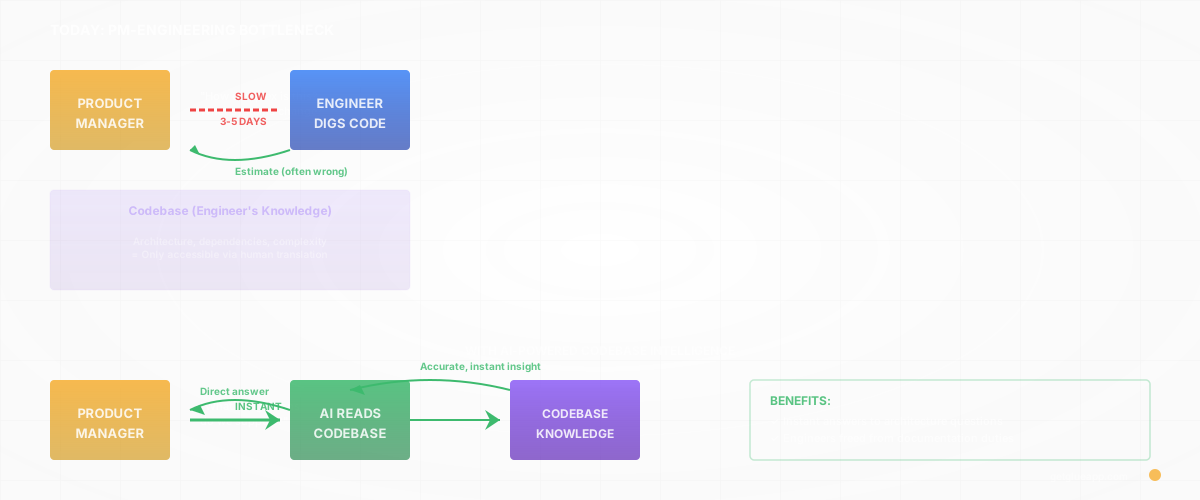
AI-powered codebase intelligence changes this dynamic fundamentally. Instead of going through an engineer, the PM queries the codebase directly. Not by reading code - by asking questions in natural language and getting answers grounded in the actual state of the system.
"What integrations do we currently support?" Not from a marketing page that might be outdated, but from the code that actually handles integrations.
"If we wanted to add webhook support, what systems would need to change?" Not an engineer's estimate from memory, but an analysis of the actual dependency graph.
"Which parts of our codebase have only one person who understands them?" This is a product risk question that no PM tool before codebase intelligence could answer.
This is why I built Glue. The thesis is that the PM-engineering information gap is the single biggest drag on product velocity, and it's solvable through AI that reads code and translates it into strategic insight. Not to replace engineers - to stop wasting their time being human documentation systems.
AI for Specs, Planning, and Strategy
Beyond codebase understanding, here's how AI should fit into the rest of the PM workflow. I'm deliberately being specific about which tools and approaches work, because the generic advice ("use AI for everything!") is useless.
Writing specs. Use ChatGPT or Claude with a template. Feed it the feature brief, the target user, and the success metrics. Let it generate a first draft. Then rewrite it - because the first draft will be correct on structure and wrong on specifics. The value is in the structure, not the content. Total time savings: 40-60% on spec writing, which frees up hours for the parts of PM work that actually require judgment.
Analyzing customer feedback. Feed your NPS comments, support tickets, or interview transcripts into an LLM. Ask it to cluster by theme, identify frequency, and flag outliers. Then spend your time on the interpretation: which themes align with your strategy? Which represent a vocal minority? Which signal a market shift? The clustering is the commodity task. The interpretation is your job.
Sprint planning support. Use AI to analyze past sprint outcomes: what was estimated versus what was delivered, which types of stories consistently overran, where were the surprises. This historical pattern analysis is something AI does well and humans do poorly because we're biased toward remembering the recent past. Feed these patterns into your planning process to calibrate estimates.
Strategic framing. Use AI to stress-test your strategy. "What are the three strongest arguments against this product direction?" "What assumptions am I making that could be wrong?" "If a competitor launched this feature tomorrow, how would it change our position?" This is the highest-leverage use of AI in product management - not generating content, but generating challenge. Most PMs don't have a thought partner who pushes back on their thinking. AI can be that partner.
Where This Is Going
The next three years will see a convergence that changes how PMs work fundamentally.
AI that understands codebases will merge with AI that understands markets, customers, and competitive dynamics. Instead of using five separate tools - a CI platform, a feedback tool, a spec generator, a codebase analyzer, a project management system - PMs will have a unified intelligence layer that connects all of these.
"Should we build Feature X?" will be answerable not with an opinion but with an analysis: here's what it would take to build (from the codebase), here's what customers want (from feedback data), here's what competitors have (from CI data), here's what similar features have cost historically (from project data).
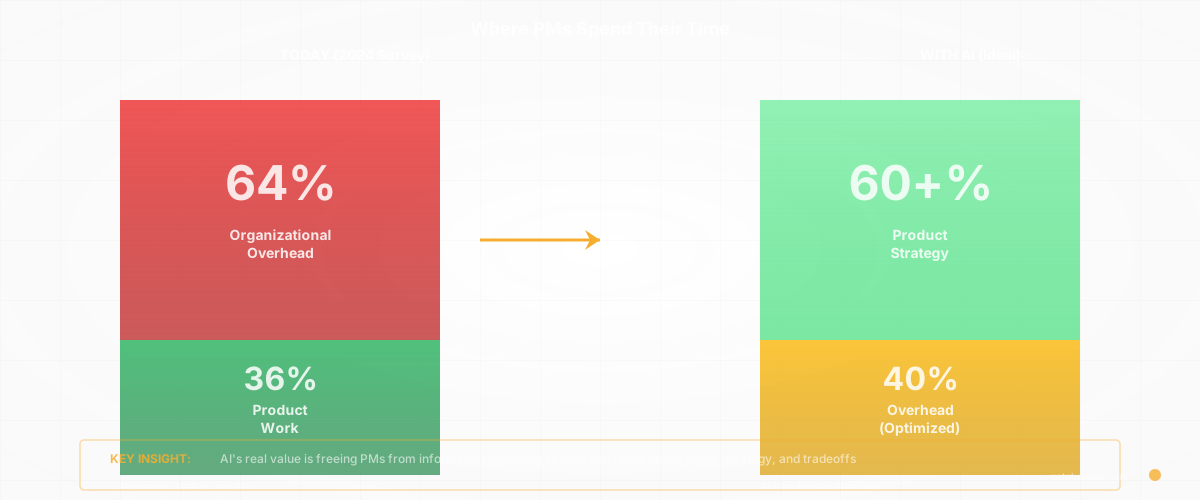
The PM's job will shift from information gathering to decision making. The information will be available, continuously updated, and grounded in reality rather than estimates. The hard part - deciding what matters, making tradeoffs, aligning stakeholders - will still be human.
That shift can't come fast enough. Right now, PMs spend the majority of their time collecting information. A 2024 Productboard survey found that PMs spend 64% of their time on "organizational overhead" - meetings, status updates, information requests - and only 36% on actual product work. AI should invert that ratio.
The product managers who thrive in this shift will be the ones who use AI to understand their product deeply, not just to produce artifacts quickly. The difference between producing more and understanding more is the difference between a PM who writes documents and a PM who drives product strategy.
Frequently Asked Questions
Q: What does an AI product manager do?
A: An AI product manager combines traditional product management skills — roadmap prioritization, user research, stakeholder alignment — with expertise in machine learning systems, data pipelines, and model behavior. Unlike conventional PMs, AI PMs must manage probabilistic outputs (models that are right 90% of the time still fail 10%), training data quality, model drift, and the gap between demo performance and production reliability. The best AI PMs use codebase intelligence tools to understand how ML models connect to the rest of the system without needing to read the underlying code.
Q: What are the leading AI product management tools?
A: The leading AI product management tools include Glue (codebase intelligence translating code into product-relevant insights), Pendo (usage analytics for AI feature adoption), Amplitude (behavioral data for ML-powered products), Productboard (roadmap planning with AI prioritization), and LaunchDarkly (feature flagging for gradual ML model rollouts). The most impactful tools are ones that give PMs new information about their product rather than just helping them produce documents faster.
Q: How are product managers using AI in 2026?
Most PMs use AI for document generation (PRDs, user stories, meeting summaries) and feedback analysis. A smaller number use it for competitive monitoring and estimation support. Very few are using AI for codebase understanding or strategic decision support, which is where the highest leverage lies.
Q: What AI tools actually help PMs think strategically?
Tools that provide new information, not just faster production. Codebase intelligence tools (like Glue) that translate code into product-relevant insights, competitive intelligence platforms with AI analysis (like Crayon), and general LLMs used as strategic thought partners for stress-testing assumptions and exploring alternatives.
Q: Can AI help PMs understand their codebase?
Yes, and this is arguably AI's most important application for PMs. Codebase intelligence tools analyze your code directly and answer questions in natural language: what systems exist, how they connect, where complexity is concentrated, and what the impact of proposed changes would be. This gives PMs access to technical understanding without requiring them to read code.
Related Reading
- AI for Product Management: The Difference Between Typing Faster and Thinking Better
- The Product Manager's Guide to Understanding Your Codebase
- AI Product Discovery: Why What You Build Next Should Not Be a Guess
- Cursor for Product Managers: The Next AI Shift Nobody Is Talking About
- Product OS: Why Every Engineering Team Needs an Operating System
- Software Productivity: What It Really Means and How to Measure It
- AI for Product Managers Guide
- Will AI Replace Project Managers?